The Ultimate Guide to LEED Certification and Training in the Arab World

The Ultimate Guide to LEED Certification and Training in the Arab World
In today’s rapidly evolving world, sustainability is no longer a luxury but a necessity. As cities expand and resources become more strained, the construction industry faces increasing pressure to adopt greener, more efficient solutions. LEED (Leadership in Energy and Environmental Design) has become the gold standard for evaluating and certifying green buildings worldwide. For engineers, developers, and organizations across the Arab world, obtaining LEED Certification opens the door to international opportunities, professional recognition, and long-term value in the real estate and construction markets.
What is LEED in Green Building?
Before diving into the details of the certification process, it’s important to understand what LEED represents. LEED is a globally recognized rating system developed by the U.S. Green Building Council (USGBC).
- It sets benchmarks for energy efficiency, water management, indoor air quality, and sustainable materials.
- A project certified under LEED demonstrates a commitment to reducing environmental impact while improving occupant health and comfort.
- For professionals, mastering LEED standards means gaining expertise in one of the most in-demand areas of modern construction.
In short, LEED is not just a certificate—it’s a framework for building a healthier, greener future.
The Goals and Global Importance of LEED Certification
Every certification system has a purpose, but what sets LEED apart is its comprehensive approach to sustainability. The goals of LEED Certification can be summarized into five key pillars:
- Reducing energy and water consumption through advanced and efficient technologies.
- Enhancing indoor environmental quality by improving ventilation, natural lighting, and pollutant control.
- Lowering carbon emissions and minimizing the overall environmental footprint.
- Promoting a green economy by encouraging the use of local, sustainable materials.
- Increasing property value by making certified projects more attractive to investors and tenants.
Globally, LEED Certification has become a passport for projects to enter international markets, with recognition in over 180 countries. For developers and engineers, it is a powerful way to demonstrate environmental and social responsibility while gaining a competitive edge.
Why is LEED Certification Considered a Global Quality Standard?
LEED has become the most trusted benchmark for sustainable construction worldwide. But why?
- Comprehensive evaluation: LEED uses a rigorous point-based system that covers site selection, energy efficiency, water management, air quality, and innovation.
- Market credibility: Projects with LEED Certification stand out to investors, buyers, and governments seeking healthier, more efficient buildings.
- Long-term savings: Certified buildings often reduce operational and maintenance costs significantly.
- International recognition: LEED is not limited to the U.S.—it is a seal of quality accepted around the globe.
Ultimately, LEED is more than a technical standard; it is a stamp of trust and excellence that elevates projects in both local and global markets.
Types of LEED Certifications and Their Differences
LEED is not one-size-fits-all. Instead, it provides flexibility by offering different certification categories depending on the project type. Here are the main types:
- LEED BD+C (Building Design and Construction)
For new construction and major renovations—ideal for residential, commercial, and healthcare projects. - LEED O+M (Operations and Maintenance)
Focused on existing buildings, ensuring they are operated and maintained sustainably over time. - LEED ID+C (Interior Design and Construction)
Designed for interior fit-outs, such as offices, retail spaces, and commercial interiors. - LEED ND (Neighborhood Development)
For large-scale developments, integrating transportation, green spaces, and sustainable community planning.
- LEED Homes
Tailored specifically to residential housing, emphasizing comfort, efficiency, and sustainable living.
Each type of certification addresses a specific scope and set of priorities, ensuring that LEED adapts to the needs of diverse projects.
Step-by-Step Guide to Achieving LEED Certification
For many engineers and developers, the process of obtaining LEED Certification may seem complex at first. Here’s a simplified breakdown of the essential steps:
- Understand LEED and its categories – Familiarize yourself with the framework and decide which certification fits your project.
- Choose the appropriate certification type – Whether it’s BD+C, O+M, or Homes, the right choice determines success.
- Register through USGBC – Submit your project via the official platform and pay the initial registration fees.
- Prepare for the LEED Green Associate Exam – This exam is the entry point for professionals aiming to get certified.
- Submit project documentation – Upload supporting evidence of sustainability measures implemented.
- Receive certification – Projects are awarded levels: Certified, Silver, Gold, or Platinum, depending on points achieved.
For Arab engineers, platforms like LEED Tricks provide localized training, including LEED Courses in Arabic, which make the process easier and more accessible.
LEED Green Associate Exam: Structure and Preparation
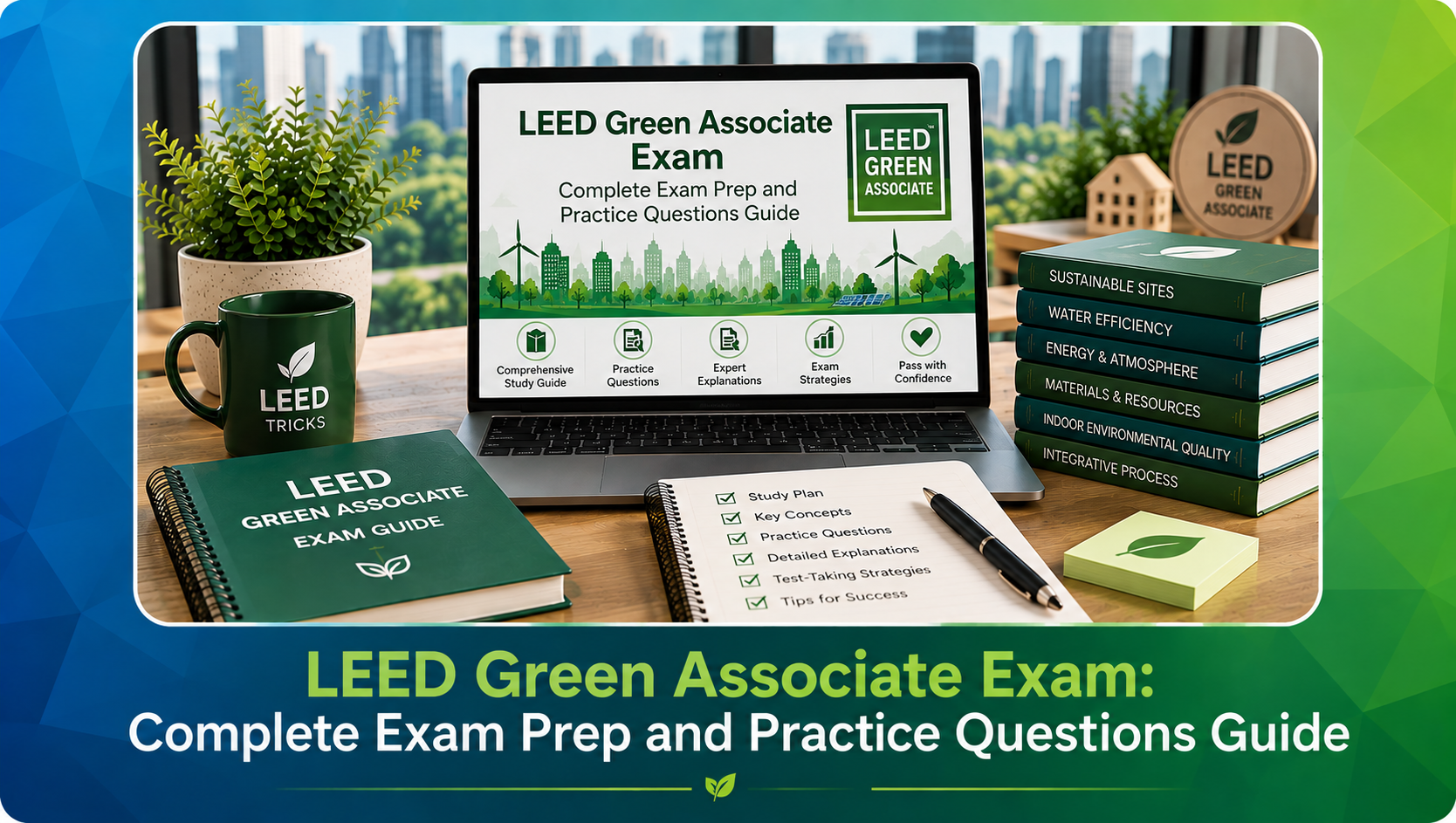
The LEED Green Associate Exam is the first step for professionals entering the world of sustainable design. It ensures a solid foundation in LEED principles.
- Exam structure: 100 multiple-choice questions, 2 hours to complete.
- Content areas:
- Introduction to LEED concepts and benefits.
- Core categories: Energy, Water, Materials, Indoor Quality.
- Processes: registration, documentation, and point allocation.
- Professional ethics and responsibilities.
How to prepare effectively:
- Study the official USGBC guide.
- Solve practice questions to understand the exam format.
- Use localized training platforms like LEED Tricks’ Arabic Course for simplified explanations.
- Create a study schedule that covers all areas before the exam.
Common Mistakes in Preparing for LEED Certification
Preparation for LEED is not just about memorizing facts. Many candidates fall into avoidable traps:
Relying on memorization instead of understanding.
Ignoring practice tests.
Poor time management.
Using outdated or unreliable resources.
To avoid these pitfalls, focus on deep understanding, regular practice exams, balanced study plans, and up-to-date resources. Platforms like LEED Tricks provide exactly that.
Why LEED Tricks Arabic Course is the Best Option for Arab Engineers
One of the biggest challenges Arab engineers face when preparing for LEED is the language barrier. This is where the LEED Tricks Arabic Course makes a difference:
- Delivered fully in Arabic for maximum clarity.
- Covers all exam topics in a simple, structured way.
- Includes realistic practice exams and simulations.
- Offers flexible study schedules tailored for busy professionals.
- Provides ongoing support from certified sustainability experts.
This combination ensures that engineers can prepare effectively without struggling with complex terminology or outdated resources.
Practical Tips to Maximize Your Training with LEED Tricks
To get the most out of your training journey, consider the following strategies:
- Set a clear study plan – Dedicate consistent time weekly.
- Apply lessons in real projects – Practical application strengthens learning.
- Take practice tests regularly – Monitor your progress and readiness.
- Engage in discussions – Interact with trainers and peers to deepen understanding.
- Review content multiple times – Reinforce your memory before the exam.
- Seek expert guidance – Don’t hesitate to ask for help from certified trainers.
By following these steps, you’ll move beyond simply studying for the exam and become fully equipped to implement LEED practices in real-world projects.
Conclusion
Sustainability is shaping the future of construction, and LEED Certification has become the benchmark for professionals aiming to thrive in this field. For Arab engineers, the LEED Tricks Arabic Course bridges the gap between ambition and achievement, offering accessible, updated, and practical training.
Whether you are a young engineer seeking your first international credential or an experienced professional aiming to expand your expertise, LEED Certification is your gateway to global opportunities. With the right preparation, support, and resources, you can join the next generation of engineers driving change toward a greener, more sustainable future.
Latest posts
Copyright | LEED-Tricks All Rights Reserved . Made with MiskIts