LEED v5: The Future of Sustainable Building and the Path to Net Zero Emissions

LEED v5: The Future of Sustainable Building and the Path to Net Zero Emissions
In the context of the accelerating global shift toward reducing carbon emissions and achieving environmental sustainability, the construction sector has become one of the most critical areas undergoing a comprehensive redefinition of design, execution, and operational standards. The discussion of sustainable buildings is no longer an optional feature, but a strategic necessity directly linked to the future of cities and economies.
From this perspective, the LEED system has emerged as one of the most widely adopted and globally recognized green building rating systems, with its continuous development reflecting a direct response to growing environmental challenges.
Brief Introduction to LEED v5 and Its Importance in the Future of Sustainable Construction
LEED v5 (Leadership in Energy and Environmental Design) is the latest version of the global certification system developed by the U.S. Green Building Council (USGBC). It aims to elevate sustainability standards in buildings to a more comprehensive and rigorous level.
This version is distinguished by its deep focus on actual building performance rather than theoretical design alone. It strengthens key areas such as carbon emission reduction, energy efficiency, occupant health, and resource management. Therefore, it does not merely assess how “green” a building is, but evaluates its real environmental and social impact throughout its entire lifecycle.
Why the New Generation of LEED Represents a Major Shift Compared to LEED v4.1
LEED v5 represents a fundamental evolution compared to LEED v4.1, moving from incremental improvements to a clear strategic reorientation toward deep sustainability.
The key aspects of this shift include:
- Stronger emphasis on reducing both operational and embodied carbon.
- Broader integration of climate resilience concepts.
- Greater weight given to actual post-occupancy performance metrics rather than design intent only.
- Higher standards that push the market toward innovative solutions instead of minimum compliance approaches.
This transformation makes LEED v5 more aligned with global environmental realities and positions it as a sustainable performance management tool rather than just a certification system.
Alignment with Net Zero Emissions Goals
LEED v5 is directly aligned with the global transition toward Net Zero Carbon, one of the key objectives of international climate agreements.
The system focuses on reducing emissions in two main areas:
- Operational emissions resulting from energy and water consumption within buildings.
- Embodied emissions associated with materials and construction processes.
As a result, LEED v5 becomes a practical tool that helps developers and engineers design buildings capable of actively contributing to carbon neutrality rather than simply reducing environmental impact partially.
Quick Note on the Importance of LEED Green Associate v5 Certification
With the advancement of LEED standards, professional certifications have become increasingly important, particularly the LEED Green Associate v5, which serves as the primary entry point for understanding sustainable building systems according to the latest global standards.
This certification is no longer limited to engineers; it is now widely required across real estate, project management, and sustainability-related professions, as it demonstrates a practical understanding of how LEED principles are applied in real-world projects.
How to Choose the Right Path in LEED v5
Selecting the appropriate LEED v5 pathway is a crucial step, as it defines the scope of evaluation, requirements, and standards applied to the project. This choice depends primarily on the project type and development stage, whether it is a new building, an existing structure, or an interior design project.
LEED v5 offers greater flexibility in classification compared to previous versions, covering the building lifecycle more comprehensively and focusing on actual performance.
Understanding the Main LEED v5 Rating Systems
LEED v5 is divided into three main rating systems:
1. Building Design and Construction (BD+C)
This pathway is used for projects in the design and construction phase or major renovations.
It includes:
- New construction projects
- Core and Shell developments
- Fully designed and executed buildings
Key advantages:
- Focuses on early design decisions
- Emphasizes energy efficiency and carbon reduction
- Addresses material selection and environmental footprint
- Suitable for developers and consultants during design and construction stages
In LEED v5, this pathway has become more stringent in assessing real environmental performance rather than theoretical compliance.
2. Operations and Maintenance (O+M)
This pathway is designed for existing, operational buildings.
It includes:
- Operational facilities such as offices, schools, and public buildings
- Improving environmental performance of existing buildings
- Recertification processes
Key advantages:
- Relies on actual performance and consumption data
- Focuses on reducing energy and water usage during operation
- Enhances long-term building efficiency
- Connects certification to real operational performance
In LEED v5, this pathway increasingly emphasizes continuous performance monitoring and real operational carbon emissions.
3. Interior Design and Construction (ID+C)
This pathway focuses on interior spaces within buildings.
It includes:
- Tenant improvements and office design
- Retail and commercial interiors
- Enhancing indoor environmental quality
Key advantages:
- Focuses on Indoor Environmental Quality (IEQ)
- Uses sustainable materials and finishes
- Improves occupant health and comfort
- Suitable for interior design firms and engineering consultants
In LEED v5, this pathway strengthens the link between sustainability and user experience within spaces.
Summary of Pathway Selection
- BD+C → New construction or development projects
- O+M → Existing operational buildings
- ID+C → Interior spaces within buildings
Factors Influencing LEED v5 Path Selection
1. Project Type
Project type is the most influential factor, distinguishing between:
- New construction
- Existing buildings
- Interior-only projects
Each category corresponds to a specific LEED pathway.
2. Development Stage
The project stage plays a crucial role:
- Early design → BD+C
- Operation phase → O+M
- Interior fit-out → ID+C
Early selection improves scoring potential and reduces future modification costs.
3. Sustainability Objectives
Objectives vary by project, such as:
- Reducing carbon emissions
- Improving energy efficiency
- Enhancing indoor environmental quality
- Achieving Net Zero targets
LEED v5 allows alignment with these priorities in a flexible way.
Role of LEED v5 Scorecard in Decision-Making
The LEED v5 scorecard is a key analytical tool that helps teams understand project performance and potential credits before and during certification.
Updated Point System
LEED v5 emphasizes real sustainability performance rather than formal compliance.
It evaluates:
- Energy and carbon emissions
- Water efficiency
- Materials
- Indoor environmental quality
- Location and sustainability
Carbon reduction is now a top priority category.
How to Read the Scorecard
- Each category has a defined number of achievable points
- Points depend on design and technical decisions
- Final score determines certification level (Certified – Silver – Gold – Platinum)
This enables early identification of strengths and weaknesses.
Setting Environmental Priorities
The scorecard helps to:
- Identify high-impact categories
- Focus efforts on the most valuable credits
- Develop a cost-effective sustainability strategy
It becomes a strategic decision-making tool, not just an evaluation form.
How LEED v5 Prepares Buildings for Net Zero Emissions
LEED v5 strongly supports the global transition toward Net Zero buildings by addressing emissions across the entire lifecycle.
Concept of Net Zero Buildings
Net Zero Carbon Buildings are those where carbon emissions are balanced by reductions or offsets, resulting in a near-zero net impact.
Operational vs Embodied Carbon
- Operational Carbon:
- Electricity consumption
- Heating and cooling
- Equipment operation
- Embodied Carbon:
- Material production
- Transportation and construction
- Maintenance and replacement
LEED v5 gives equal importance to both.
Key Strategies
- Renewable energy use (solar, wind, local generation)
- High energy efficiency systems (HVAC, insulation, smart lighting)
- Low-carbon materials (recycled, local, low-emission concrete)
- Efficient water management systems
Climate Resilience and Extreme Weather Strategies
Climate change has made extreme weather a major challenge for buildings.
Impacts
- Flooding damages infrastructure and disrupts systems
- Heat waves increase energy demand and reduce comfort
- Severe storms damage building envelopes and structures
LEED v5 Approach
- Integration of climate resilience into design
- Climate-adaptive buildings
- Disaster-resistant structures
- Strategic site selection avoiding high-risk zones
Practical Design Strategies
- Advanced drainage systems and green roofs
- High-performance thermal insulation
- Climate-resistant materials and structures
Comparison Between LEED v4.1 and LEED v5
Key Differences
- LEED v5 focuses on carbon as the central metric
- Stronger weighting for energy and emissions
- Real performance over theoretical design
- Alignment with global Net Zero goals
Philosophical Shift
- v4.1: Focus on efficiency
- v5: Focus on environmental impact
Question shift:
- v4.1: Does the building use less energy?
- v5: How much carbon does the building emit across its lifecycle?
Future Outlook
LEED v5 is considered the future standard because it:
- Centers carbon reduction
- Integrates lifecycle thinking
- Aligns with global climate strategies
- Enforces measurable environmental impact
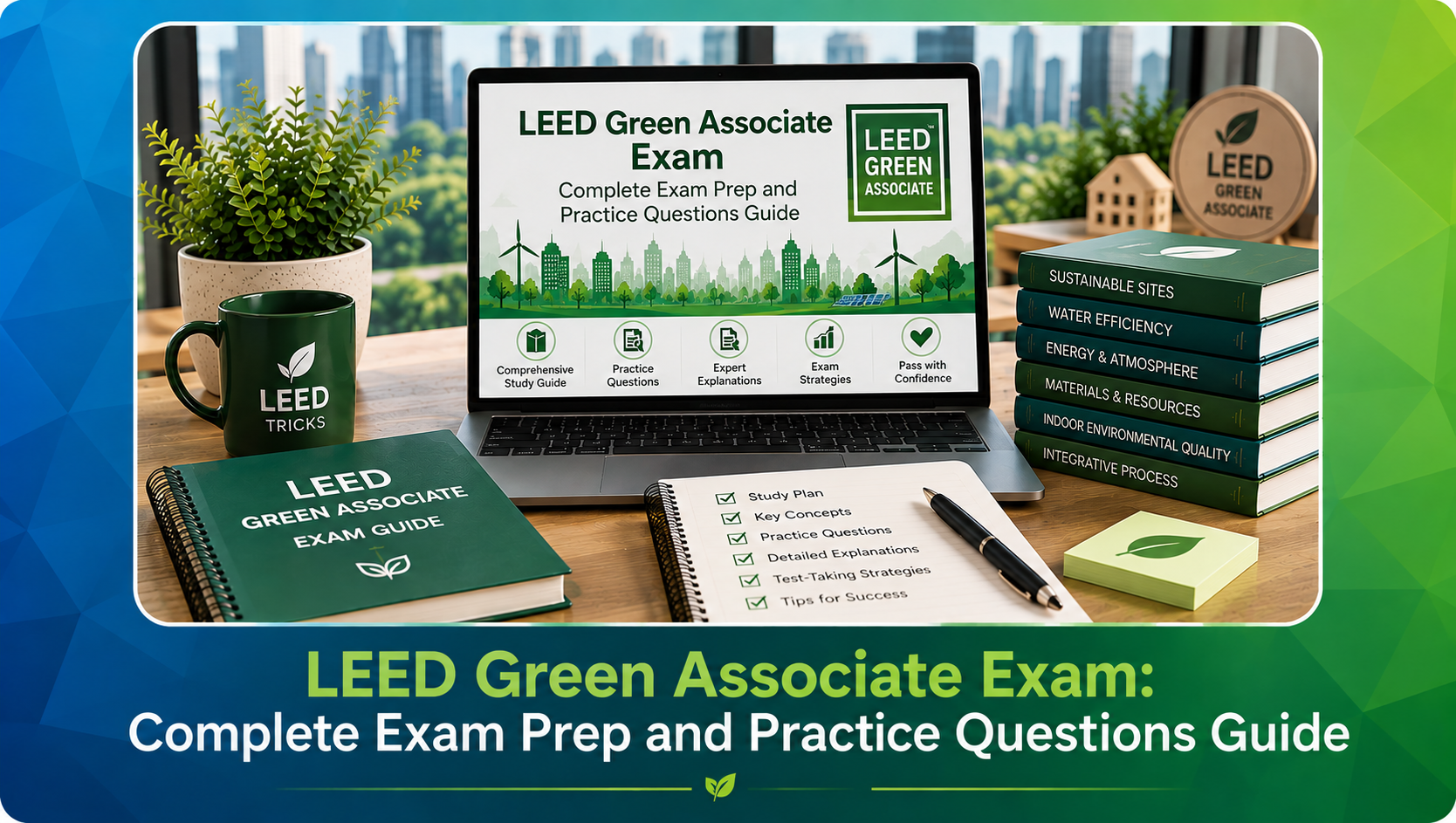
LEED Exam Preparation (LEED Green Associate v5)
Exam Overview
The LEED Green Associate v5 exam evaluates understanding of:
- Sustainability principles
- LEED system structure
- Environmental building practices
It does not require deep technical expertise.
Target Audience
- Architects and engineers
- Sustainability consultants
- Project managers
- Real estate professionals
- Students in architecture and engineering
Key Study Areas
- Sustainability fundamentals
- LEED system structure and pathways
- Scorecard understanding
- Carbon reduction strategies
Study Strategy
- Understand concepts rather than memorizing
- Break study material into small sections
- Use real-world examples
- Practice exam questions regularly
Difference Between v4.1 and v5 Exams
- v5 includes stronger focus on carbon and Net Zero
- More advanced sustainability integration
- Requires deeper understanding of lifecycle impacts
Conclusion
LEED v5 represents a significant advancement in global green building standards. It redefines sustainability by focusing not only on efficiency but on real building performance throughout its lifecycle.
It serves as a strategic framework guiding the construction industry toward a low-carbon future by reducing emissions, improving energy efficiency, and promoting sustainable resource use.
In this rapidly evolving field, professional knowledge has become essential rather than optional. Therefore, pursuing the LEED Green Associate v5 certification is a critical step for anyone aiming to build a strong career in green buildings and sustainability, and to understand the future direction of the global construction industry.
You can also check out:
LEED O+M - LEED Green Associate - LEED AP BD+C - كورسات ليد تركس - GPM-b - leed - Tricks Courses - leed -
GPM-b - LEED - LEED v4.1 و LEED v5
Latest posts
Copyright | LEED-Tricks All Rights Reserved . Made with MiskIts