Why Sustainability Should Start at Design — Not During Construction
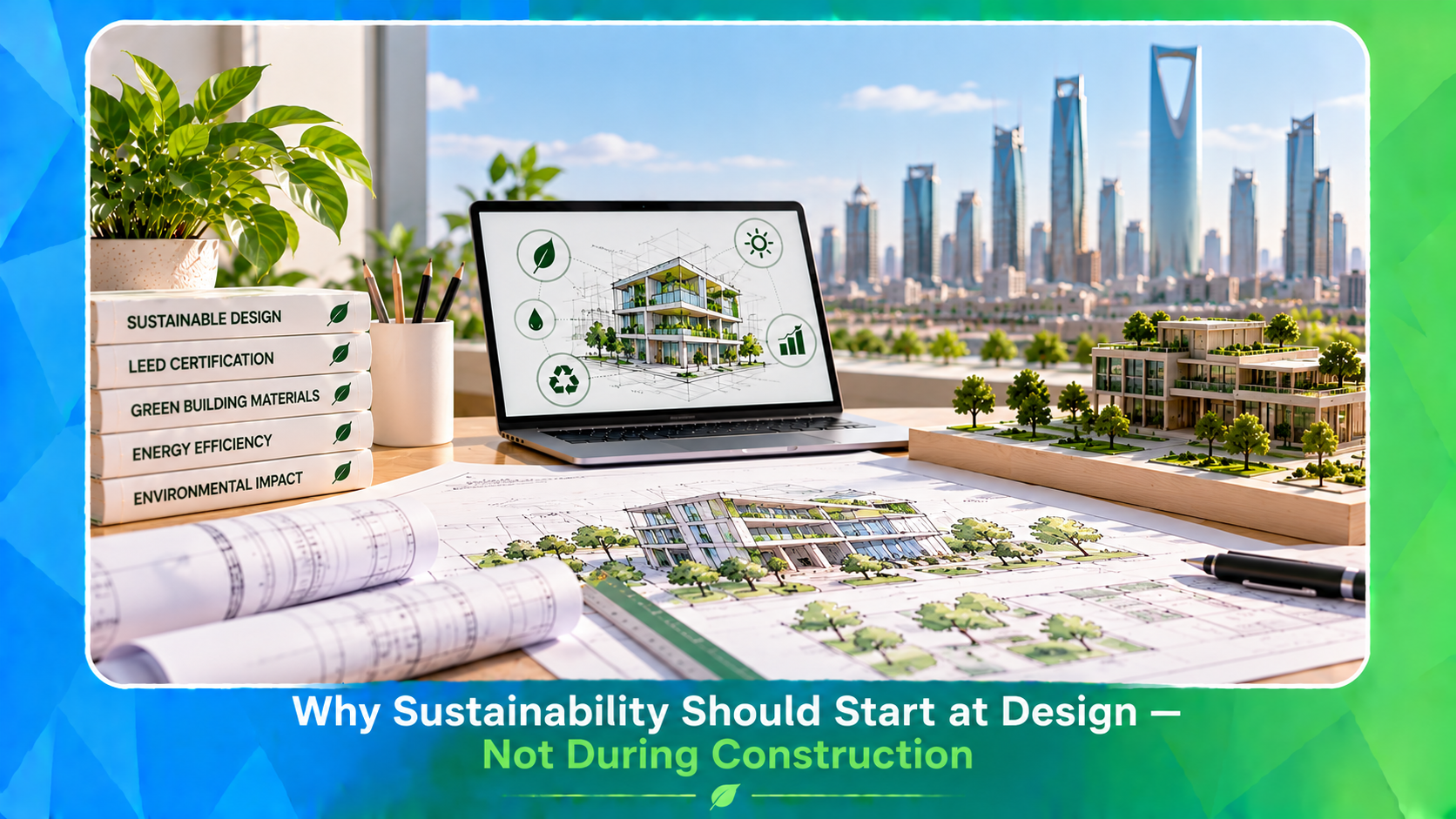
Why Sustainability Should Start at Design — Not During Construction
Sustainability is no longer an optional feature that can simply be added to a building near the end of a project. It is increasingly becoming a fundamental part of how buildings are planned, designed, constructed, and operated.
Yet many projects still treat sustainability as something that can be addressed after the main design decisions have already been made.
This approach can create significant challenges.
By the time construction begins, many of the decisions that determine a building’s energy performance, water efficiency, indoor environmental quality, material use, and long-term operating costs may already be locked in.
Changing those decisions later can be expensive, disruptive, or technically difficult.
That is why sustainable building strategies should begin during the earliest stages of design.
Early design decisions can influence almost every aspect of a building’s performance. Building orientation, massing, envelope design, glazing, daylighting, mechanical systems, water strategies, materials, and interior conditions all interact with one another.
For professionals working with LEED, this integrated approach is particularly important.
In this article, we will explore why sustainability should start at design rather than during construction, how early decisions influence building performance, why integrated design matters, and how engineers, architects, and project teams can incorporate sustainable strategies from the beginning.
Why Should Sustainability Start at the Design Stage?
The design stage is where many of the decisions that shape a building’s future performance are made.
Architects and engineers determine the building’s orientation, form, envelope, glazing, space planning, mechanical systems, lighting strategies, and other critical components.
These decisions can have a long-term impact on energy consumption, water use, occupant comfort, maintenance requirements, and environmental performance.
When sustainability is introduced early, project teams have the opportunity to evaluate different strategies before the design becomes fixed.
For example, changing a building’s orientation during early design may be relatively straightforward. Changing the orientation after construction has started is an entirely different challenge.
The same principle applies to building envelope performance, window selection, daylighting, HVAC systems, and water strategies.
This is why sustainable design is not simply about adding environmentally friendly products to a project.
It is about making better decisions from the beginning so that sustainability becomes part of the building itself rather than a collection of late-stage additions.
How Do Early Design Decisions Affect Building Performance?
Early design decisions can influence multiple performance categories simultaneously.
Building orientation can affect solar exposure and energy demand.
The shape of the building can influence the surface area exposed to outdoor conditions.
Window-to-wall ratios can affect daylight availability, solar heat gain, views, and thermal performance.
The building envelope can influence heating and cooling loads.
Interior planning can affect daylight distribution, ventilation, and occupant comfort.
These relationships demonstrate why sustainable buildings require an integrated approach.
For example, increasing glazing may improve daylight access, but excessive glazing can also increase unwanted solar heat gain if it is not carefully designed.
The objective is therefore not to optimize one individual component in isolation.
Instead, project teams should consider how architectural, mechanical, electrical, water, and material decisions interact.
This approach is often referred to as integrated design, and it is one of the most effective ways to improve sustainable building performance before construction begins.
What Happens When Sustainability Is Introduced During Construction?
When sustainability is postponed until construction, the project team may face a much more limited set of options.
The architectural design may already be approved.
Mechanical systems may already have been selected.
Materials may have already been specified or purchased.
Construction contracts may already be in place.
At this point, implementing major sustainability strategies can require redesign, substitutions, additional coordination, schedule changes, or increased costs.
For example, if energy analysis reveals that the building envelope is underperforming after construction has started, improving the envelope may be much more difficult than addressing the issue during design.
The project may then have to rely more heavily on mechanical systems to compensate for a problem that could have been reduced through early design decisions.
This does not mean sustainability cannot be improved during construction.
It can.
However, the range of available strategies is usually broader and more flexible when sustainability goals are established before major design decisions are finalized.
The Connection Between Sustainable Design and LEED
The LEED rating system encourages project teams to consider sustainability across multiple areas of building performance.
These areas can include site considerations, water efficiency, energy performance, materials, indoor environmental quality, and integrated project strategies.
Because these categories interact, sustainability should not be treated as a checklist that is completed at the end of construction.
Instead, LEED goals can be incorporated into the design process from the beginning.
A project team can establish performance objectives early and then evaluate how architecture, engineering systems, materials, and construction strategies can contribute to those objectives.
This approach can also make LEED implementation more efficient because the team has more time to evaluate alternatives before decisions become difficult to change.
Professionals studying for LEED AP BD+C can benefit from understanding this relationship between design decisions, construction processes, and building performance.
The goal is not simply to achieve individual LEED requirements but to understand how sustainable strategies work together.
Sustainable Design Can Reduce Energy Demand
Energy performance is one of the clearest examples of why sustainability should start during design.
A building’s energy demand can be influenced by its orientation, massing, envelope, glazing, insulation, shading, daylighting, and internal planning before mechanical systems are even selected.
When these factors are considered early, designers can evaluate different scenarios and determine how each option affects energy performance.
For example, reducing unwanted solar heat gain through appropriate orientation and shading may reduce cooling demand.
Improving the building envelope can reduce heat transfer.
Increasing effective daylighting can potentially reduce dependence on artificial lighting during appropriate conditions.
These strategies do not eliminate the need for efficient mechanical systems.
Instead, they can reduce the loads that mechanical systems need to address.
This leads to an important principle in green building design:
The most effective energy strategy is not always adding a more sophisticated system.
Sometimes it is designing the building so that it requires less energy in the first place.
Water Efficiency Should Also Begin During Design
Water efficiency is another area where early decisions can have long-term consequences.
Design teams can evaluate water demand, plumbing systems, fixtures, irrigation strategies, landscaping, and potential alternative water sources during the early stages of a project.
For example, landscape design can influence irrigation requirements.
Plumbing fixture selection can affect indoor potable water consumption.
Building systems can also influence water demand depending on the project's operational requirements.
If these strategies are considered during design, the team can compare alternatives before systems are finalized.
If water efficiency is introduced late in construction, the available options may be limited by previously selected systems and specifications.
Therefore, water efficiency should be considered as part of the overall sustainable design strategy rather than treated as a last-minute construction adjustment.
Why Should Sustainable Materials Be Selected Early?
Material selection can have significant environmental, financial, and operational implications.
Sustainable material selection is not simply about choosing products marketed as green.
Teams may need to consider durability, performance, sourcing, environmental impacts, recycled content where relevant, responsible production, maintenance, and end-of-life considerations.
The earlier these factors are considered, the more opportunities the project team has to compare alternatives.
Early material decisions can also reduce the risk of late substitutions that create coordination problems or affect project schedules.
For LEED projects, material-related strategies should therefore be considered alongside architectural and engineering decisions rather than after the design has already been completed.
This reinforces an important principle:
Sustainability in construction starts with better decisions before construction begins.
Indoor Environmental Quality Starts With Design
A sustainable building is not simply a building that consumes fewer resources.
It should also provide a healthy, comfortable, and productive environment for its occupants.
Indoor environmental quality can be influenced by daylight, ventilation, air quality, thermal comfort, acoustics, materials, and space planning.
Many of these factors are strongly connected to early design decisions.
Window placement can influence daylight and views.
Space planning can influence access to natural light.
Mechanical system design can affect ventilation and indoor air quality.
Envelope design can influence thermal comfort.
If these issues are considered early, the project team has greater flexibility to develop integrated solutions.
Waiting until construction to address indoor environmental quality can make improvements more difficult and expensive.
For this reason, indoor environmental quality should be treated as an integral part of sustainable design.
Why Integrated Design Matters
One of the strongest reasons to start sustainability during design is the need for collaboration between disciplines.
Sustainability is not the responsibility of the architect alone.
It is not the responsibility of the mechanical engineer alone.
It requires collaboration among architects, engineers, sustainability consultants, contractors, owners, and other project stakeholders.
A change in architectural design can affect mechanical loads.
A mechanical system can affect energy consumption and operating costs.
Material selection can affect indoor environmental quality and environmental performance.
This is why an integrated design process can be so valuable.
Instead of allowing each discipline to work independently and discovering conflicts during construction, the team can evaluate important interactions while changes are still relatively manageable.
Early collaboration can therefore improve performance, reduce redesign, and help the project make more informed decisions.
Does Sustainable Design Always Cost More?
A common misconception is that sustainable design automatically means significantly higher construction costs.
The reality is more nuanced.
Some sustainability strategies may require additional upfront investment.
Others can be implemented with limited additional cost, particularly when they are considered early.
More importantly, some sustainable strategies may reduce operational expenses over the life of the building.
This is why sustainable design should be evaluated using a life cycle thinking approach rather than looking only at initial construction cost.
A strategy that appears more expensive during construction may generate long-term value through lower energy consumption, reduced water use, improved durability, or lower operating costs.
Timing also matters.
A design decision made early may be relatively inexpensive to modify.
The same decision made after construction has started may require redesign, demolition, replacement, or schedule changes.
Early sustainability planning can therefore improve both environmental and financial decision-making.
How Can Engineers Integrate Sustainability Into Design?
Engineers can play a critical role in integrating sustainability into building design.
The process should begin with clear project objectives.
What level of energy performance is required?
What are the water efficiency goals?
How should indoor environmental quality be addressed?
What materials and systems support the project's sustainability objectives?
How will building performance be evaluated?
Once these goals are established, engineers can work with architects and other disciplines to evaluate potential strategies.
Energy modeling, performance analysis, daylight studies, system comparisons, and other analytical approaches can help the team make informed decisions before construction begins.
Professionals pursuing LEED AP BD+C can also benefit from understanding how these strategies interact throughout the project lifecycle.
The goal is to move beyond isolated sustainability measures and develop a coordinated approach to building performance.
A Practical Example: Designing for a Hot Climate
Consider an office building located in a hot climate.
If sustainability is introduced during the design stage, the team can evaluate building orientation, façade design, glazing, shading, insulation, daylighting, and HVAC requirements before the design is finalized.
Energy analysis can then help the team understand how different combinations affect cooling loads and annual energy performance.
Now consider the same project after construction has started.
If analysis reveals excessive solar heat gain, changing the building orientation is no longer realistic.
The team may have to rely on additional shading systems, upgraded glazing, or mechanical solutions.
Some of these measures may be effective, but they can also introduce additional costs and coordination challenges.
The example illustrates a broader principle:
Sustainability is most powerful when it influences the decisions that shape the building rather than being used to correct those decisions later.
The Role of LEED Training in Sustainable Design
Understanding sustainable building strategies requires more than memorizing definitions.
Professionals need to understand how sustainability concepts translate into real project decisions.
LEED Training can help engineers, architects, consultants, and other building professionals develop a stronger understanding of green building principles and how they relate to project performance.
For professionals preparing for the LEED AP BD+C Exam, understanding integrated design and sustainable strategies can also provide a stronger foundation for exam preparation.
At LEED Tricks, our training approach focuses on helping professionals understand LEED concepts, prepare for certification exams, and develop knowledge that can be applied beyond the examination itself.
The objective is to connect learning with practical understanding.
Why Sustainability Should Be a Project Strategy From Day One
When sustainability becomes part of the project strategy from the beginning, teams can make better decisions.
Instead of asking near the end of the project, “What sustainable features can we add?” the team starts by asking:
How can we design this building to achieve the best possible performance within the project's budget, climate, program, and technical constraints?
That change in mindset can significantly improve the project.
It allows teams to compare alternatives early.
It provides more flexibility.
It can reduce late-stage changes.
It encourages collaboration.
And it creates a stronger connection between design decisions and long-term building performance.
This is why sustainability should start at design rather than during construction.
The building's future performance is influenced long before construction begins.
Frequently Asked Questions About Sustainable Design
Why should sustainability start during design?
Because many decisions made during design influence energy, water, materials, indoor environmental quality, and long-term building performance. Changing those decisions later can be more difficult and expensive.
Can sustainability be added during construction?
Yes, some strategies can be introduced during construction. However, postponing sustainability can reduce available options and increase the risk of redesign, delays, and additional costs.
Why is sustainable design important for LEED?
Sustainable design allows project teams to integrate LEED goals into fundamental project decisions rather than trying to address requirements after the design is complete.
Does sustainable design cost more?
Not necessarily. Some strategies may require additional upfront investment, while others can reduce operating costs or have limited additional cost when incorporated early.
What is integrated design?
Integrated design is a collaborative approach in which different project disciplines work together early to optimize building performance and sustainability.
Can engineers benefit from LEED training?
Yes. LEED training can help engineers and other building professionals understand how sustainability principles influence design, construction, and building performance.
Conclusion
Sustainability should not begin when construction workers arrive on site.
It should begin when the first project decisions are being made.
Building orientation, massing, envelope design, energy systems, water strategies, materials, daylighting, ventilation, and indoor environmental quality can all be influenced before construction begins.
The earlier sustainability becomes part of the design process, the more flexibility project teams have to evaluate alternatives and achieve better performance.
The most successful sustainable buildings are not simply conventional buildings with green features added at the end.
They are buildings that were conceived with performance, efficiency, occupant well-being, and environmental responsibility in mind from the beginning.
Design sustainably first. Then build according to that vision.
If you are an engineer, architect, consultant, or building professional looking to strengthen your knowledge of sustainable design and LEED, explore LEED Tricks courses and training programs designed to help you develop practical LEED knowledge and prepare for professional certification.
Latest posts
Copyright | LEED-Tricks All Rights Reserved . Made with MiskIts