The Role of a Sustainability Manager in Major Construction Projects
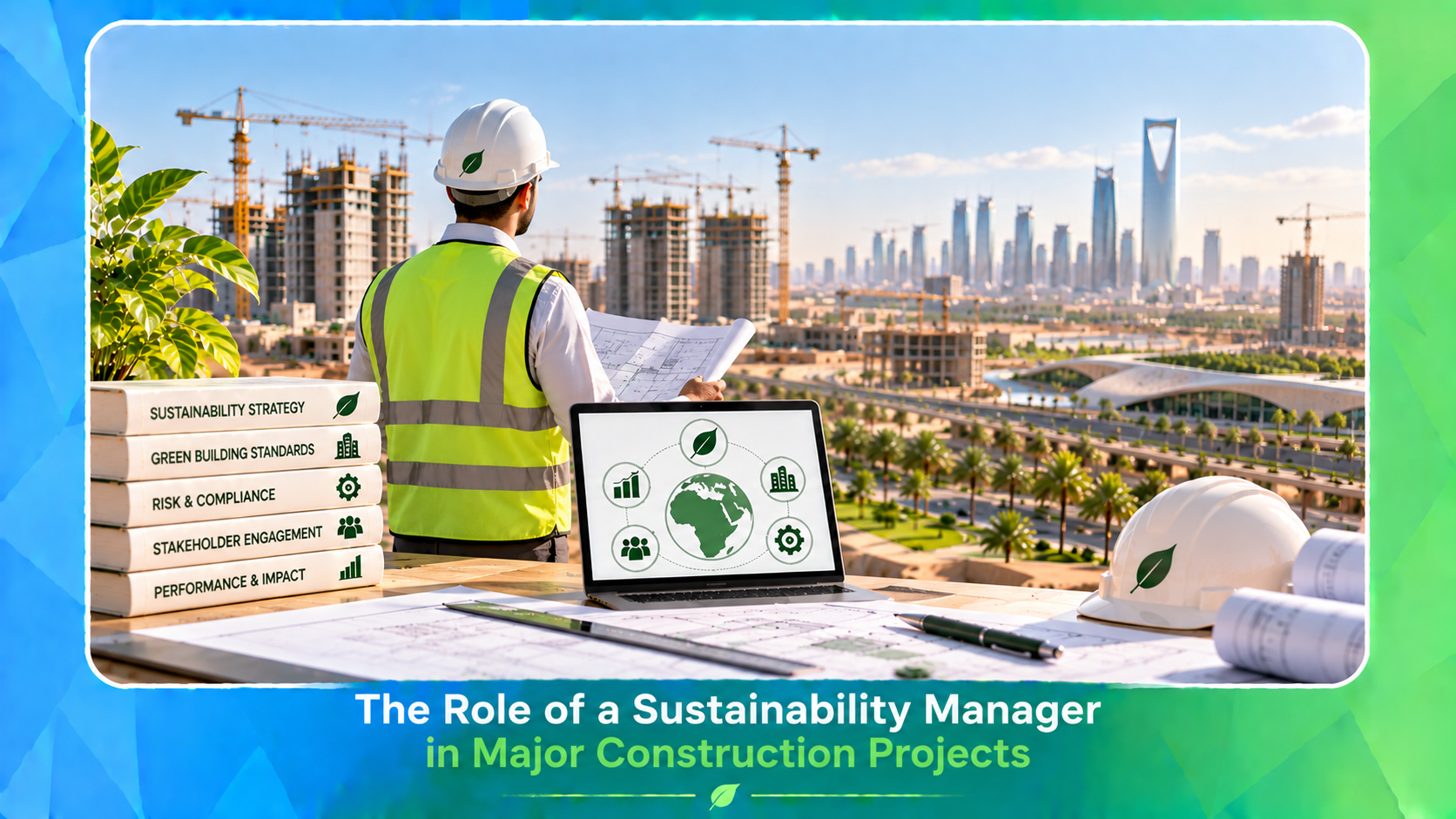
The Role of a Sustainability Manager in Major Construction Projects
Sustainability has become a strategic priority in major construction projects around the world.
As buildings become more complex and large-scale developments continue to expand, project teams need professionals who can integrate sustainability into planning, design, construction, commissioning, and operations.
This is where the Sustainability Manager plays a critical role.
The role is much broader than managing a green building certification.
A Sustainability Manager helps define sustainability objectives, coordinates with architects and engineers, monitors project requirements, supports certification strategies, tracks environmental performance, and helps ensure that sustainability goals are translated into measurable project outcomes.
In major construction projects, the role becomes even more important because multiple consultants, contractors, suppliers, and project packages must work toward common sustainability objectives.
A successful Sustainability Manager therefore needs both technical knowledge and strong project coordination skills.
The professional must understand green building principles while also knowing how to communicate requirements, manage stakeholders, interpret performance data, and solve problems during different project stages.
This makes The Role of a Sustainability Manager in Major Construction Projects increasingly relevant for professionals looking to build careers in sustainable construction and green building.
Who Is a Sustainability Manager and Why Does the Role Matter?
A Sustainability Manager is responsible for coordinating and managing sustainability objectives across a project's lifecycle.
The position typically involves areas such as energy efficiency, water efficiency, materials, waste management, indoor environmental quality, carbon reduction, sustainable design, environmental compliance, and green building certification.
However, the Sustainability Manager is not simply a person who checks whether project teams are meeting sustainability requirements.
The role is fundamentally about integration.
A Sustainability Manager may work with architects to evaluate sustainable design strategies, engineers to review energy and water systems, contractors to monitor construction practices, procurement teams to assess materials, and operations teams to prepare for long-term building performance.
This requires the ability to translate broad sustainability goals into specific actions and measurable requirements.
For example, if a project has an energy reduction target, the Sustainability Manager should not simply record the target.
They should help ensure that design decisions support it, systems are properly implemented, and performance can eventually be measured against the original objective.
Sustainability Manager vs. LEED Consultant
The roles of a Sustainability Manager and a LEED Consultant can overlap, but they are not necessarily the same.
A LEED Consultant typically focuses on the requirements of the applicable LEED rating system, certification strategy, documentation, credit compliance, and coordination with the certification process.
A Sustainability Manager usually has a broader responsibility.
The manager may oversee sustainability across design, construction, procurement, environmental performance, operational preparation, and project-wide sustainability objectives.
For example, the Sustainability Manager may participate in design reviews, coordinate sustainability requirements with contractors, review material strategies, monitor waste performance, and establish project sustainability KPIs.
LEED may be an important component of this work, but it is not the entire scope.
This broader perspective allows the Sustainability Manager to help projects move beyond simply achieving certification toward delivering measurable sustainability performance.
Why Sustainability Management Should Start During Planning
One of the most common mistakes in sustainable construction is treating sustainability as something that can be added later.
The greatest opportunities for influencing project performance often exist during the earliest planning and design stages.
A Sustainability Manager can participate in defining project sustainability goals before major design decisions are finalized.
This may include energy targets, water reduction goals, carbon objectives, material requirements, waste targets, indoor environmental quality objectives, and certification goals.
Early involvement also allows teams to evaluate alternatives before changes become expensive or difficult.
For example, building orientation, envelope design, glazing selection, shading, HVAC strategies, and energy systems can have major effects on performance.
If sustainability considerations are introduced only after these decisions have been made, the project may have fewer opportunities to optimize performance.
This is why an effective Sustainability Manager should be involved from the beginning rather than being brought into the project only during construction.
The Sustainability Manager's Role During Design
Design is one of the most important stages for influencing the sustainability performance of a building.
During this phase, the Sustainability Manager works with architects, engineers, energy consultants, and other specialists to evaluate sustainable strategies.
This can include reviewing building envelope performance, energy modeling, daylighting, thermal comfort, indoor air quality, water efficiency, material selection, and waste strategies.
The Sustainability Manager should also encourage integrated design.
A building envelope should not be selected only for architectural appearance.
Its impact on thermal loads, energy consumption, daylight, and occupant comfort should also be evaluated.
Similarly, HVAC systems should be considered in relation to the architectural design and building loads rather than being designed as an isolated system.
This integrated approach can help project teams identify solutions that improve overall performance instead of optimizing individual components independently.
Managing LEED Certification
For projects pursuing LEED certification, the Sustainability Manager can play an important role in organizing and coordinating the certification strategy.
The process may begin by identifying the applicable LEED rating system and establishing the project's certification goals.
The team can then determine which credits and prerequisites are relevant and assign responsibilities to the appropriate disciplines.
The Sustainability Manager may track documentation, monitor progress, coordinate meetings, and identify potential compliance issues before they become major problems.
However, LEED management should not become purely administrative.
The strongest approach is to connect certification requirements with actual project performance.
For example, energy-related requirements should support real energy efficiency.
Water strategies should contribute to measurable water savings.
Indoor environmental quality requirements should support occupant health and comfort.
This approach turns LEED into part of the project's sustainability strategy rather than a separate documentation exercise.
Energy and Resource Management
Energy is one of the most important areas of sustainability management in many major construction projects.
The Sustainability Manager can coordinate with energy specialists and engineering teams to evaluate energy efficiency strategies and compare design alternatives.
Potential strategies may include high-performance building envelopes, efficient HVAC systems, optimized lighting, advanced controls, renewable energy, energy monitoring, and operational optimization.
Water should also be addressed through an integrated strategy.
This can involve efficient fixtures, irrigation management, landscape design, water reuse opportunities, and monitoring systems.
The key is to consider energy and water as part of a broader resource management strategy.
The Sustainability Manager helps ensure that these strategies are aligned with the project's objectives and properly coordinated across disciplines.
Materials and Construction Waste Management
Materials represent another important area of sustainability management.
Major construction projects can consume enormous quantities of concrete, steel, glass, timber, finishes, and other materials.
The environmental impact of these materials can depend on their sourcing, manufacturing, transportation, durability, and end-of-life characteristics.
A Sustainability Manager may work with procurement teams, contractors, and suppliers to establish material requirements and verify relevant documentation.
Construction waste is another important responsibility.
Instead of focusing only on how much waste leaves the site, sustainability teams can look for opportunities to prevent waste in the first place.
Better planning, accurate material quantities, reuse, recycling, and improved site segregation can all contribute to better resource efficiency.
This demonstrates how the Sustainability Manager can influence decisions rather than simply report outcomes.
The Sustainability Manager During Construction
The construction phase is where sustainability strategies developed during design must become actual site practices.
The Sustainability Manager may monitor whether contractors are following project sustainability requirements and whether environmental management procedures are being implemented correctly.
Responsibilities can include construction waste management, dust control, pollution prevention, material tracking, indoor air quality measures, resource efficiency, and documentation.
Major projects can involve multiple contractors and subcontractors, making coordination particularly challenging.
The Sustainability Manager therefore needs strong communication and problem-solving skills.
Written requirements are only effective when site teams understand them and can implement them consistently.
This makes collaboration with construction management and contractors a critical part of sustainability management.
Measuring Performance Instead of Just Meeting Design Targets
One of the most important developments in sustainable construction is the shift from certification to performance.
A project may have been designed according to ambitious sustainability standards.
But what happens after occupancy?
Does actual energy consumption match the model?
Is water use within the expected range?
Are HVAC systems operating efficiently?
Is indoor environmental quality meeting project objectives?
The Sustainability Manager can help establish Key Performance Indicators that allow teams to compare actual performance with the project's sustainability goals.
When performance gaps appear, the team can investigate the underlying causes and identify corrective actions.
This turns sustainability into a continuous improvement process rather than a one-time achievement.
Data and Reporting in Sustainability Management
Major construction projects generate large amounts of sustainability-related data.
A Sustainability Manager needs to organize this information and turn it into useful insights for project teams and leadership.
Data may include energy consumption, water use, waste quantities, material information, environmental testing results, indoor environmental quality indicators, and certification progress.
Effective reporting should go beyond presenting numbers.
A good sustainability report should explain whether the project is meeting its targets, where performance gaps exist, what risks have emerged, and what actions are recommended.
As smart buildings and Building Management Systems become increasingly common, data will become even more important.
Sustainability Managers will increasingly need to understand how to interpret data and use it to support better project decisions.
Skills Required to Become a Sustainability Manager
A successful Sustainability Manager needs a combination of technical and professional skills.
Technical knowledge may include green building principles, energy efficiency, water management, materials, waste, indoor environmental quality, carbon, and sustainable design.
Knowledge of rating systems such as LEED can also be highly valuable.
However, technical knowledge alone is not enough.
Sustainability Managers must communicate effectively with architects, engineers, contractors, clients, consultants, and senior management.
They need project coordination skills, time management, negotiation abilities, reporting skills, and problem-solving capabilities.
Data literacy is also becoming increasingly important as sustainability management becomes more performance-driven.
For professionals developing this career path, structured LEED Training can provide a valuable foundation in green building concepts and certification frameworks.
Can LEED AP Help Build a Sustainability Management Career?
A LEED AP credential can be a valuable addition for professionals interested in sustainable construction and green building leadership.
It demonstrates advanced knowledge of LEED and the principles associated with a specific LEED specialty, such as Building Design and Construction.
However, a credential should not be viewed as a replacement for practical project experience.
The strongest Sustainability Managers combine professional credentials with technical expertise, project experience, communication skills, and the ability to analyze real-world performance.
LEED preparation can therefore be part of a broader professional development strategy rather than an isolated certification goal.
The Sustainability Manager in Large-Scale and Giga-Projects
The complexity of the Sustainability Manager's role increases significantly as project size increases.
A large development may contain dozens or hundreds of buildings, multiple contractors, numerous consultants, and different sustainability requirements across project packages.
This requires a structured sustainability management framework.
The framework may include project sustainability guidelines, performance targets, KPIs, reporting procedures, compliance processes, documentation requirements, and auditing mechanisms.
The Sustainability Manager may also need to create consistency across different project teams while allowing individual buildings or packages to respond to their specific requirements.
At this scale, the Sustainability Manager becomes more than a technical specialist.
They become a strategic sustainability leader responsible for aligning multiple teams toward common performance objectives.
The Future of the Sustainability Manager Profession
The sustainability profession is evolving rapidly.
Future Sustainability Managers will likely need to understand more than certification systems.
Carbon management, energy optimization, water efficiency, operational performance, smart building technologies, data analytics, resilience, and lifecycle thinking are becoming increasingly important.
This evolution creates opportunities for engineers, architects, project managers, environmental specialists, and other professionals who want to transition into sustainable construction leadership.
The most valuable professionals will be those who can connect sustainability strategy with measurable project outcomes.
How LEED Tricks Can Help You Build Your Sustainability Career
If you are an engineer, architect, consultant, or construction professional looking to develop a career in green building, understanding LEED can provide a strong foundation.
LEED Tricks offers LEED courses and training designed to help professionals prepare for credentials such as LEED Green Associate and LEED AP while building a stronger understanding of sustainable building principles.
Whether you are starting with the LEED Green Associate credential or preparing for LEED AP, structured training can help you develop the knowledge needed to understand certification requirements and sustainable project strategies.
Start developing your LEED knowledge today and prepare for the growing opportunities in sustainable construction and green building projects.
Frequently Asked Questions
What does a Sustainability Manager do?
A Sustainability Manager develops and coordinates sustainability strategies across a project and helps ensure that goals related to energy, water, materials, waste, indoor environmental quality, carbon, and certification are properly implemented and monitored.
Is a Sustainability Manager only responsible for LEED?
No. LEED may be part of the role, but Sustainability Managers typically have broader responsibilities covering project sustainability, environmental performance, resource efficiency, and operational objectives.
Does a Sustainability Manager need a LEED certification?
Not necessarily, but credentials such as LEED Green Associate or LEED AP can strengthen professional knowledge and demonstrate expertise in green building practices.
What skills does a Sustainability Manager need?
The role requires technical sustainability knowledge combined with communication, project coordination, data analysis, reporting, stakeholder management, and problem-solving skills.
Why is a Sustainability Manager important in major construction projects?
Large projects involve multiple teams, complex systems, and significant resource consumption. A Sustainability Manager helps align these teams with common sustainability objectives and ensures that strategies are implemented and measured throughout the project lifecycle.
Conclusion
The role of a Sustainability Manager in major construction projects has evolved far beyond managing certification documents.
Today, the position is increasingly focused on integrating sustainability into project decisions, coordinating multidisciplinary teams, monitoring environmental performance, and helping projects achieve measurable outcomes.
From planning and design to construction, commissioning, and operations, the Sustainability Manager helps transform sustainability goals into practical strategies.
As green buildings and large-scale developments continue to expand, professionals who can combine technical sustainability expertise with project management and performance analysis will become increasingly valuable.
If you want to build a stronger career in sustainable construction, explore LEED Tricks courses and training programs designed to help you develop the knowledge needed to work with modern green building projects and LEED certification.
Start Your LEED Certification Journey with LEED Tricks
Enhance your sustainability skills and get the training you need to prepare for professional certification exams with LEED Tricks courses
LEED Green Associate v5 Full Package
Everything you need to prepare for the exam in one comprehensive package including educational videos study resources flashcards chapter tests and full-length practice exams
Explore the Full Package and Get Started Now
LEED Green Associate v5 Exam Training Package
Ideal for learners who want to focus on practical exam preparation and assess their readiness through chapter tests and full-length practice exams
Explore the LEED Green Associate v5 Course
Learn more about the course content and available packages and choose the training option that best fits your goals
Explore the LEED Green Associate v5 Course
Green Project Manager GPM-b™
Develop your expertise in green project management and get specialized training to help you prepare for the Green Project Manager GPM-b™ certification
LEED AP BD+C | Arabic-English | v4
Prepare for the LEED AP BD+C credential with a bilingual Arabic-English training course designed to help you understand the exam content and prepare effectively
LEED AP O+M | Arabic-English
Enhance your knowledge of sustainable building operations and maintenance and prepare for the LEED AP O+M exam with Arabic-English training
Explore the LEED AP O+M Course
Choose the Right Course and Get Started Today
Whether you are preparing for your first LEED Green Associate certification looking to specialize as a LEED AP or aiming to develop your green project management skills LEED Tricks provides the training and resources you need to prepare with greater confidence structure and effectiveness
Take your next step toward a career in sustainability today
Latest posts
Copyright | LEED-Tricks All Rights Reserved . Made with MiskIts