Sustainability in Saudi Giga-Projects: From Certification to Performance
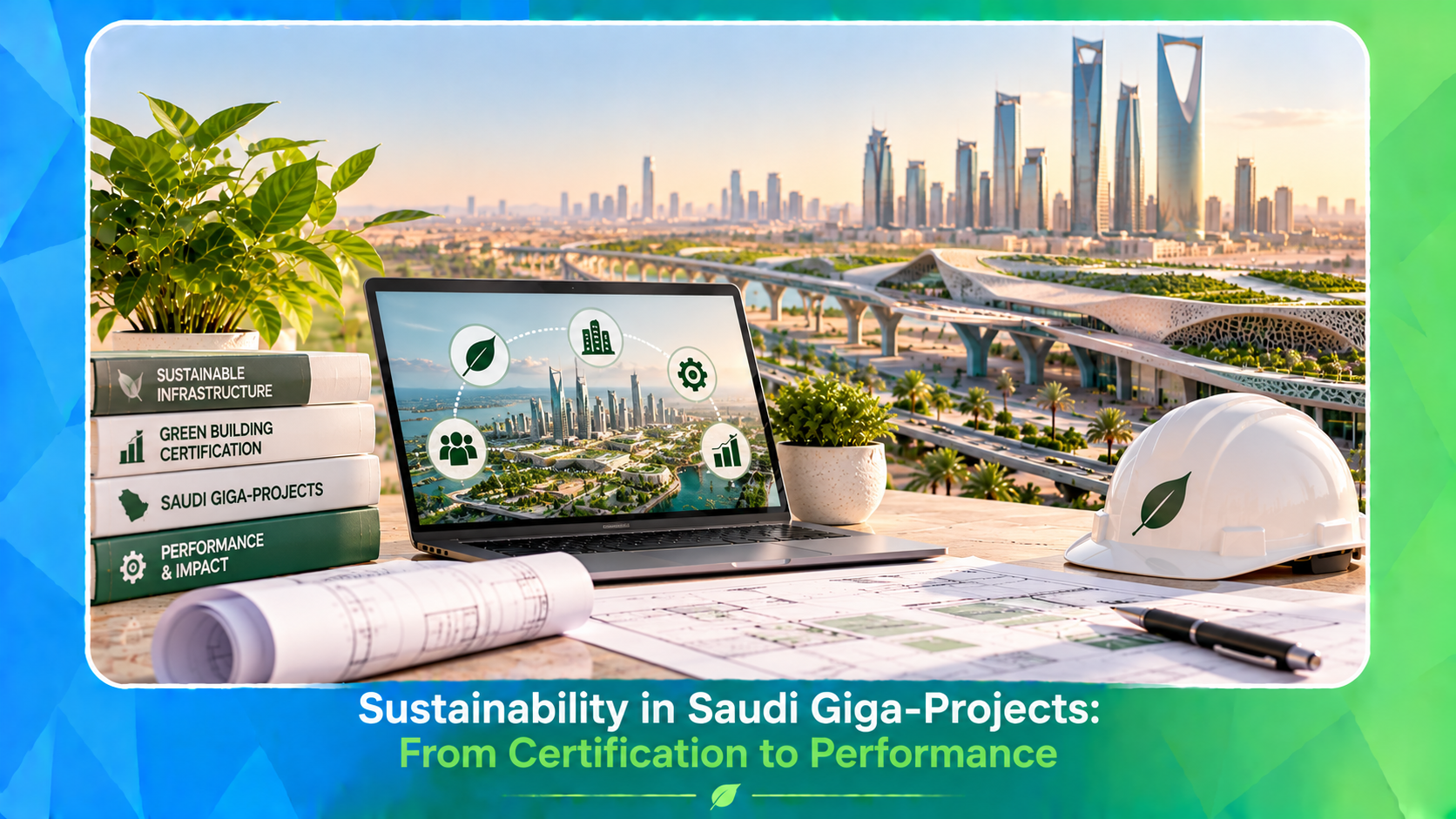
Sustainability in Saudi Giga-Projects: From Certification to Performance
Saudi Arabia is undergoing one of the most ambitious transformations in the global built environment.
Through large-scale developments, new cities, tourism destinations, infrastructure programs, and giga-projects, the Kingdom is redefining how buildings and communities are planned, designed, constructed, and operated.
Projects such as NEOM, Qiddiya, and The Red Sea destinations represent a new scale of development where sustainability cannot simply be treated as an additional project feature.
But as sustainable building practices become more common, an important question is emerging:
Is achieving a sustainability certification enough, or should projects also prove that they deliver measurable performance after completion?
This distinction represents a fundamental shift from certification to performance.
A green building certification can demonstrate that a project has met a defined set of sustainability requirements.
However, the real test begins when the building starts operating.
How much energy does it actually consume?
How efficiently does it use water?
Does the building maintain indoor environmental quality?
Are mechanical systems operating as intended?
Is the project achieving its intended carbon and resource efficiency targets?
These questions move sustainability beyond documentation and into measurable building performance.
For Saudi giga-projects, this transition is particularly important because of their scale, complexity, long operational lifespans, and challenging environmental conditions.
Why Is Sustainability a Priority for Saudi Giga-Projects?
Saudi giga-projects are part of a broader transformation of the Kingdom's economy, cities, tourism sector, infrastructure, and built environment.
Because these developments operate at an enormous scale, seemingly small design decisions can have significant cumulative effects.
A small improvement in energy efficiency across one building may be valuable.
The same improvement replicated across hundreds of buildings, hotels, public facilities, and infrastructure assets can have a much larger impact.
Saudi Arabia's climate also creates specific sustainability challenges.
High temperatures can increase cooling demand, while water scarcity makes efficient water management especially important.
This means sustainable solutions need to respond to local environmental conditions rather than simply copying strategies developed for other climates.
Design teams must consider climate, site conditions, building use, energy systems, water resources, occupant behavior, and operational requirements together.
This is where sustainability frameworks such as LEED can provide structure while performance measurement ensures that sustainability goals translate into real outcomes.
What Is the Difference Between Certification and Performance?
A sustainability certification demonstrates that a project has met a defined set of requirements within a particular rating system.
Building performance is different.
Performance refers to what the building actually does once it is occupied and operating.
A building may be designed with high-efficiency systems and sustainable materials.
But its actual performance depends on commissioning, controls, maintenance, occupant behavior, operating schedules, and many other factors.
This creates a potential gap between design intent and operational reality.
A building may have been modeled to achieve a certain energy performance level but consume significantly more energy after occupancy.
Similarly, a project may have efficient water systems but experience excessive water consumption because of operational problems or irrigation practices.
Therefore, sustainability certification should be viewed as an important milestone rather than the final destination.
The long-term objective should be measurable and continuously improved building performance.
The Role of LEED in Saudi Giga-Projects
LEED is one of the world's most recognized green building rating systems and can provide a structured framework for addressing multiple areas of sustainability.
These areas can include energy, water, materials, site considerations, indoor environmental quality, and integrated project strategies.
For large-scale developments, a common framework can be especially valuable.
Giga-projects involve large numbers of developers, consultants, contractors, suppliers, engineers, architects, operators, and other stakeholders.
A consistent sustainability framework can help create a common language across different teams and project packages.
However, the real value of LEED should go beyond collecting points.
Project teams should connect LEED strategies to actual performance objectives.
Instead of asking only how to achieve an energy-related credit, teams should also ask how the project can minimize actual energy consumption throughout its operational life.
That mindset turns LEED from a documentation exercise into a performance-oriented design framework.
Why Saudi Giga-Projects Need Performance-Based Sustainability
A giga-project cannot be evaluated only when construction is completed.
These developments may operate for decades and serve residents, visitors, businesses, and communities throughout their lifecycle.
Sustainability therefore needs to be treated as a continuous process.
It begins with planning.
Then moves into design.
Then construction.
Then commissioning.
Then operation.
Then measurement and optimization.
This is the foundation of performance-based sustainability.
Instead of proving only that a project was designed according to sustainability requirements, project teams should measure whether it actually achieves the intended outcomes.
If energy reduction is a target, energy consumption should be measured.
If water efficiency is a target, water use should be monitored.
If indoor environmental quality is important, appropriate performance indicators should be tracked.
This creates a feedback loop in which sustainability becomes a measurable management process rather than a static certification document.
Saudi Arabia's Climate and Sustainable Building Design
Climate is one of the most important factors influencing sustainable building design in Saudi Arabia.
High outdoor temperatures can create significant cooling requirements across many building types.
As a result, building envelope performance, solar control, insulation, glazing, shading, orientation, and mechanical system efficiency can all play critical roles.
Energy efficiency should not be treated solely as an HVAC problem.
The building's architectural design can influence the loads that mechanical systems need to handle.
A well-designed envelope can reduce unwanted heat gain.
Appropriate shading can reduce solar exposure.
Efficient glazing can support both daylighting and thermal performance when properly selected.
These decisions demonstrate the importance of integrated design, where architects, engineers, energy specialists, and other disciplines work together early in the process.
Energy Efficiency Across Saudi Giga-Projects
Energy performance is one of the most important components of sustainable development at giga-project scale.
Hotels, offices, residential buildings, retail destinations, transportation facilities, and public infrastructure can all have substantial energy requirements.
When efficiency strategies are replicated across large portfolios, relatively small improvements can generate significant cumulative benefits.
Strategies may include high-performance envelopes, efficient HVAC systems, advanced controls, efficient lighting, renewable energy integration, energy monitoring, and operational optimization.
But these strategies should not be considered independently.
The strongest results typically come from combining architectural design, mechanical systems, electrical systems, controls, and operational strategies.
Performance measurement is equally important.
A system designed to achieve high efficiency does not guarantee that the building will achieve that efficiency after occupancy.
Actual energy consumption needs to be measured, analyzed, and compared against the project's performance objectives.
Why Water Efficiency Matters in Saudi Arabia
Water is a critical sustainability issue in Saudi Arabia due to the Kingdom's climate and limited natural water resources.
This makes water efficiency an essential consideration for large developments.
Water strategies should begin during planning and design rather than being added near the end of construction.
Project teams can evaluate indoor water consumption, irrigation requirements, landscape design, plumbing systems, cooling processes, water reuse opportunities, and operational practices.
At giga-project scale, water management becomes even more complex because multiple buildings and infrastructure systems may be connected.
The objective should therefore be broader than simply installing efficient fixtures.
A comprehensive water strategy can include measurement, reuse, treatment, irrigation management, efficient systems, and ongoing operational monitoring where appropriate.
This is another example of the difference between designing a sustainable project and operating a project sustainably.
Why Life Cycle Thinking Matters
One of the biggest sustainability mistakes is focusing only on initial construction cost.
Buildings can operate for decades.
During that time, owners and operators will deal with energy costs, water consumption, maintenance, equipment replacement, operational efficiency, and other lifecycle expenses.
This makes life cycle thinking particularly important for large developments.
A system that costs more initially may deliver significant operational savings.
A durable material may have a higher upfront cost but require less replacement or maintenance.
A more efficient system may reduce energy consumption throughout the building's operational life.
Tools such as life cycle assessment and life cycle cost analysis can support better decision-making by looking beyond the initial construction budget.
For giga-projects, this approach can create significant long-term value.
The Importance of Commissioning
High-performance building systems do not automatically perform as intended.
A sophisticated HVAC system can still underperform if controls are improperly configured.
An advanced lighting system may not deliver expected savings if schedules and sensors are not correctly commissioned.
This is why commissioning plays an important role in sustainable building performance.
Commissioning helps verify that building systems have been installed, tested, and operated according to the project's requirements.
It is particularly valuable in complex developments where mechanical, electrical, control, and building systems are highly interconnected.
Commissioning should therefore not be viewed simply as a final administrative step.
It is part of the process of turning design intent into operational performance.
Data Is the Future of Sustainability Performance
Sustainability cannot be effectively managed without reliable data.
Large developments need to monitor indicators such as energy consumption, water use, indoor environmental conditions, equipment performance, and other relevant metrics.
Building Management Systems, smart meters, sensors, and data analytics platforms can provide valuable information.
However, collecting data is only the beginning.
The real value comes from using that data to make decisions.
If energy consumption is higher than expected, the team needs to determine why.
If water use increases unexpectedly, operators need to identify the source.
If occupants experience thermal discomfort, performance data can help identify potential causes.
This creates a continuous improvement process in which data becomes a practical tool for managing sustainability.
That is one of the most important differences between simply achieving certification and delivering measurable sustainable performance.
Does LEED Certification Mean a Building Is Sustainable?
LEED certification is an important achievement.
It demonstrates that a project has satisfied a defined set of sustainability requirements within the applicable rating system.
However, certification alone does not guarantee that the building will maintain its intended performance throughout its entire lifecycle.
Operating schedules can change.
Building use can change.
Equipment performance can deteriorate.
Occupant behavior can change.
Maintenance practices can influence system efficiency.
Therefore, sustainable performance requires continuous management.
Professionals who understand LEED deeply recognize that certification is not simply a document.
They understand the strategies behind the requirements and how those strategies can be maintained through operations and performance management.
The Role of Engineers in Saudi Arabia's Sustainable Building Future
Engineers will play a critical role in transforming Saudi sustainability ambitions into measurable building performance.
Sustainable buildings require expertise across energy, mechanical systems, electrical systems, water, controls, building performance, and data analysis.
They also require strong collaboration between disciplines.
For this reason, professional credentials such as LEED AP can complement technical engineering expertise for professionals working on green building and large-scale developments.
However, certification alone is not enough.
The strongest professionals combine credentials with technical knowledge, practical experience, analytical skills, and the ability to solve real project problems.
This is why high-quality LEED Training should connect theoretical knowledge with practical application.
How Can Saudi Giga-Projects Move From Certification to Performance?
The transition from certification to performance requires a lifecycle strategy.
First, projects need clear and measurable sustainability objectives.
Those objectives should influence design decisions.
During construction, project teams need to verify that systems and materials are implemented as intended.
Commissioning should confirm that systems operate correctly.
After occupancy, actual performance should be measured.
Finally, the project team should compare measured performance with the original objectives and identify opportunities for improvement.
This creates a continuous cycle:
Design → Build → Commission → Operate → Measure → Improve
This approach transforms sustainability from a static target into an ongoing performance strategy.
For Saudi giga-projects, this model can be particularly valuable because of their scale and long-term operational impact.
How LEED Tricks Can Support Sustainability Professionals
As Saudi Arabia continues developing large-scale sustainable projects, demand for professionals who understand green building systems is likely to remain strong.
LEED Tricks provides training designed to help engineers, architects, consultants, and other professionals build LEED knowledge and prepare for credentials such as LEED Green Associate and LEED AP.
The objective is not simply to pass an examination.
Effective LEED education should help professionals understand how sustainability connects with design, construction, commissioning, operations, and building performance.
For professionals planning to work on major Saudi developments or build careers in sustainable construction, investing in specialized knowledge can provide a stronger foundation for the evolving green building market.
Frequently Asked Questions About Sustainability in Saudi Giga-Projects
What does the shift from certification to performance mean?
It means moving beyond proving that a project meets sustainability requirements and focusing on whether the completed and operating project actually delivers measurable energy, water, environmental, and operational performance.
Why is sustainability important for Saudi giga-projects?
Their enormous scale, long operational lifespans, resource requirements, environmental impact, and economic significance make sustainability a critical part of long-term project performance.
Is LEED suitable for projects in Saudi Arabia?
LEED can provide a globally recognized framework for addressing multiple areas of sustainable building performance. Project teams should also consider local climate, regulations, site conditions, and project-specific requirements.
Why is energy efficiency important in Saudi Arabia?
High temperatures can create substantial cooling demand, making efficient building design, high-performance envelopes, mechanical systems, controls, and operations important components of sustainable performance.
Why is water efficiency especially important?
Saudi Arabia's climate and limited natural water resources make efficient water management a key sustainability priority for buildings and large-scale developments.
Does LEED certification guarantee sustainable performance?
No. Certification demonstrates that defined requirements have been met, but maintaining strong performance requires effective commissioning, operation, maintenance, monitoring, and continuous improvement.
What is the role of commissioning?
Commissioning helps verify that building systems are installed, tested, and operating according to the project's requirements and performance objectives.
Conclusion
The future of sustainability in Saudi giga-projects should not be measured only by the number of certifications achieved.
It should be measured by what those projects actually deliver.
A truly sustainable development should be able to translate design goals into measurable outcomes in energy, water, resources, occupant experience, and environmental performance.
That requires sustainability to begin during planning and design and continue through construction, commissioning, operations, measurement, and optimization.
As Saudi Arabia continues developing some of the world's most ambitious projects, the demand for professionals who understand sustainability as a performance discipline, rather than simply a certification process, will continue to grow.
If you want to strengthen your LEED knowledge and prepare for a career in sustainable buildings and large-scale developments, explore LEED Tricks courses and professional training programs designed to help you build the knowledge needed for the next generation of green building projects.
Start Your LEED Certification Journey with LEED Tricks
Enhance your sustainability skills and get the training you need to prepare for professional certification exams with LEED Tricks courses
LEED Green Associate v5 Full Package
Everything you need to prepare for the exam in one comprehensive package including educational videos study resources flashcards chapter tests and full-length practice exams
Explore the Full Package and Get Started Now
LEED Green Associate v5 Exam Training Package
Ideal for learners who want to focus on practical exam preparation and assess their readiness through chapter tests and full-length practice exams
Explore the LEED Green Associate v5 Course
Learn more about the course content and available packages and choose the training option that best fits your goals
Explore the LEED Green Associate v5 Course
Green Project Manager GPM-b™
Develop your expertise in green project management and get specialized training to help you prepare for the Green Project Manager GPM-b™ certification
LEED AP BD+C | Arabic-English | v4
Prepare for the LEED AP BD+C credential with a bilingual Arabic-English training course designed to help you understand the exam content and prepare effectively
LEED AP O+M | Arabic-English
Enhance your knowledge of sustainable building operations and maintenance and prepare for the LEED AP O+M exam with Arabic-English training
Explore the LEED AP O+M Course
Choose the Right Course and Get Started Today
Whether you are preparing for your first LEED Green Associate certification looking to specialize as a LEED AP or aiming to develop your green project management skills LEED Tricks provides the training and resources you need to prepare with greater confidence structure and effectiveness
Take your next step toward a career in sustainability today
Latest posts
Copyright | LEED-Tricks All Rights Reserved . Made with MiskIts