LEED Green Associate Exam Questions: Practice and Mock Exam Guide
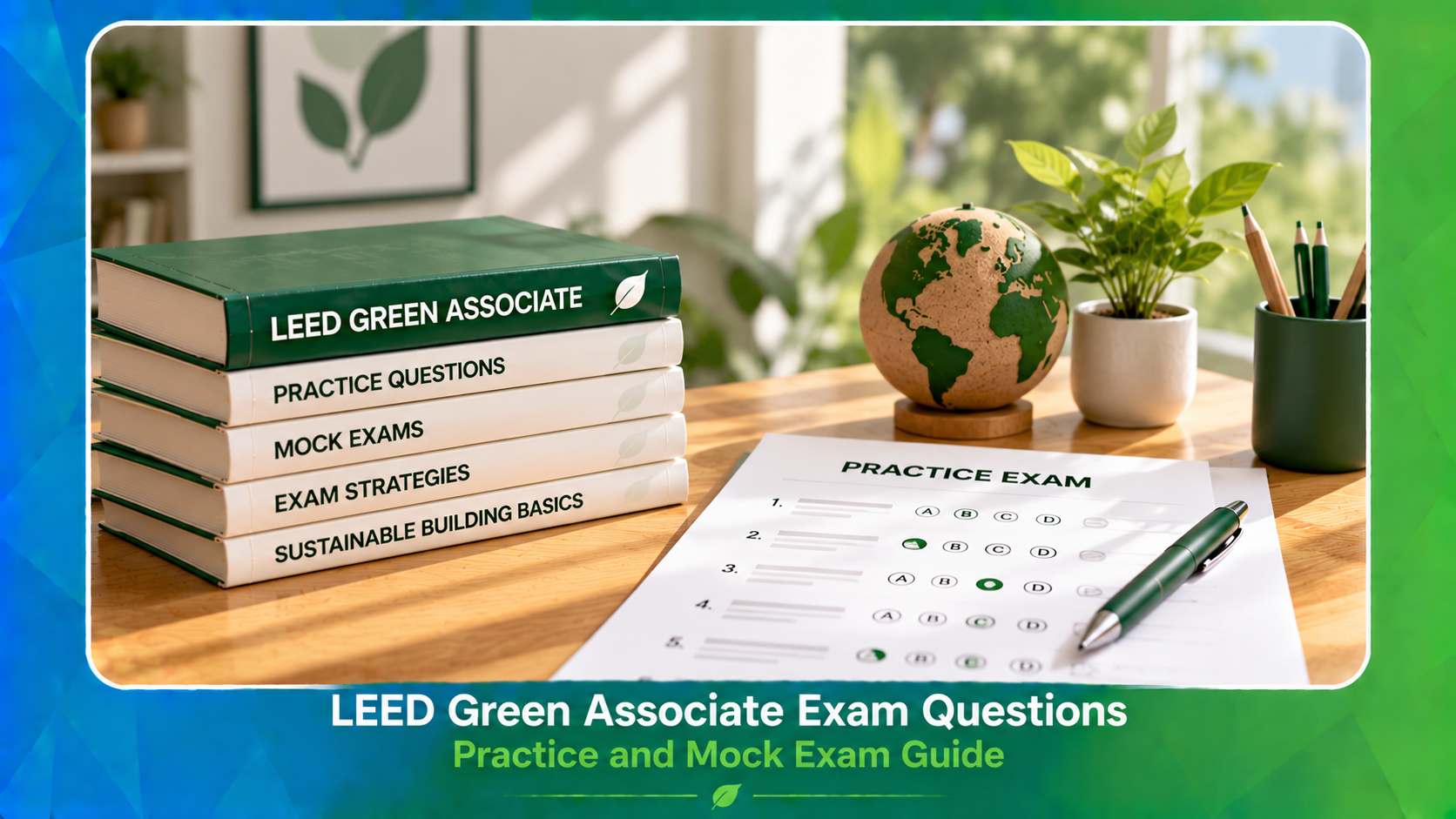
LEED Green Associate Exam Questions: Practice and Mock Exam Guide
Preparing for the LEED Green Associate exam requires more than reading study materials and memorizing terminology. Candidates also need to know whether they can apply what they have learned when faced with exam-style questions.
This is where LEED Green Associate Exam Questions become an important part of the preparation process.
Practice questions can help you test your understanding, identify knowledge gaps, become familiar with different question styles, and build confidence before the actual exam.
However, effective practice is not about answering the largest possible number of questions.
The goal is to understand why an answer is correct, identify why mistakes happen, and use those mistakes to improve your knowledge.
This guide explains how to use LEED Green Associate Exam Questions effectively, how to combine practice questions with study and review, how mock exams can support your preparation, and how to turn incorrect answers into useful learning opportunities.
Why Are LEED Green Associate Exam Questions Important?
Studying LEED concepts can provide you with theoretical knowledge, but practice questions help you determine whether you can actually use that knowledge.
When you answer a question, you are not simply testing your ability to remember information.
You are also testing your ability to recognize the relevant concept, understand the context, compare possible answers, and select the most appropriate option.
This makes LEED Green Associate Exam Questions an important part of a complete preparation strategy.
Practice questions can also reveal weaknesses that may not be obvious while reading.
You may feel confident about a topic because the material seems familiar, but questions can show that you are still confusing certain concepts or terminology.
That information is valuable because it tells you exactly where additional review is needed.
What Should You Expect From LEED Green Associate Exam Questions?
Practice questions should not be treated as a list of answers that you need to memorize.
Their main purpose is to develop your ability to understand and apply the concepts you have studied.
Questions can vary in difficulty and wording.
Some may test your understanding of a particular concept, while others may require you to distinguish between related ideas or identify the most appropriate strategy.
For this reason, it is better to practice with a variety of questions instead of repeatedly answering questions that follow exactly the same pattern.
The more varied your practice becomes, the better prepared you can be to approach unfamiliar wording.
How Should You Use LEED Green Associate Exam Questions While Studying?
A useful approach is to practice after completing each major topic.
For example, after studying a specific sustainability topic, complete a set of related practice questions.
Then review your answers.
Do not focus only on the number you answered correctly.
Pay attention to incorrect answers and questions where you selected the correct option but were not confident about your choice.
Those uncertain answers can reveal knowledge gaps even when the final result is technically correct.
Record difficult concepts and return to the relevant study material.
This turns practice questions into a learning tool rather than simply an assessment.
Should You Answer Questions Before Studying the Content?
Practice questions can be used at different stages of preparation.
However, most candidates will benefit from building a basic understanding of the material before relying heavily on questions.
You can use a small set of questions at the beginning to evaluate your current knowledge.
After studying the material, practice becomes more valuable because you can analyze the reasoning behind each answer.
During the final stage of preparation, questions and mock exams can become a larger part of your study routine.
The Importance of Reviewing Incorrect Answers
Reviewing mistakes is one of the most valuable parts of working with LEED Green Associate Exam Questions.
When you answer a question incorrectly, do not immediately move to the next one.
Ask yourself why the mistake happened.
Did you misunderstand the concept?
Did you confuse two similar terms?
Did you overlook an important word in the question?
Did you select an answer because it sounded reasonable without fully understanding the underlying concept?
Identifying the reason behind the mistake makes it easier to prevent the same error in the future.
For this reason, carefully reviewing 50 questions can sometimes be more valuable than quickly completing hundreds of questions without analyzing the results.
How Should You Organize LEED Green Associate Practice Questions?
During the early stages of preparation, organize questions by topic.
This allows you to evaluate your understanding of individual areas.
If your performance is strong in one topic, you can continue to another.
If you consistently make mistakes in another area, return to your study materials and review the relevant concepts.
After covering most of the material, move toward mixed question sets.
Mixed practice is important because you will need to move between different topics during the actual exam.
You will not always know in advance which concept a question is testing.
Training yourself to identify the relevant concept independently can make your preparation more effective.
What Is the Difference Between Practice Questions and a Mock Exam?
Practice questions and mock exams serve different purposes.
Practice Questions are generally used to test individual topics or smaller groups of concepts.
A Mock Exam provides a broader simulation of the testing experience.
When completing individual practice questions, you can stop and review an answer immediately.
During a mock exam, it is better to create conditions that are closer to a real testing session.
Avoid stopping constantly to look up answers.
Complete the session first, then review your performance.
Both methods are valuable.
Practice questions support learning throughout your preparation, while mock exams help you evaluate your overall readiness.
How Can LEED Green Associate Mock Exams Help?
Mock exams are particularly useful during the later stages of preparation.
Start with a mock exam to establish a baseline.
Then analyze the results.
Identify weak areas and return to your study materials.
After additional review and practice, complete another mock exam and compare the results.
Do not focus only on your score.
Look at the type of mistakes you are making.
Are you still struggling with the same topic?
Are you answering questions faster?
Are you more confident when selecting answers?
Can you explain why the correct answer is correct?
These indicators provide a more useful picture of your progress.
Does Answering More LEED Green Associate Questions Mean Better Preparation?
Not necessarily.
The number of questions you complete matters to some extent, but the quality of your practice is more important.
If you answer hundreds of questions without reviewing your mistakes, you may continue repeating the same errors.
On the other hand, completing fewer questions and carefully analyzing each answer can produce much more useful learning.
The goal is not to reach a specific number.
The goal is to develop a strong understanding of the concepts and become capable of applying them confidently.
How Do You Choose Good LEED Green Associate Exam Questions?
When selecting practice questions, consider several factors.
First, make sure the questions are relevant to the exam content and version you are preparing for.
Second, look for variety in topics and question difficulty.
Third, explanations are highly valuable because they help you understand the reasoning behind the answer.
Fourth, use questions as a supplement to studying rather than as a replacement for learning the material.
Finally, include both individual practice questions and broader mock exams in your preparation plan.
Why Are Answer Explanations Important?
Knowing the correct answer is not always enough.
If a question provides several possible answers, understanding why one option is correct and why the others are not appropriate can provide much deeper learning.
An explanation helps you understand the reasoning behind the question.
It also reduces the risk of memorizing answers without understanding the concept.
This becomes particularly important when you encounter a new question with different wording.
If you understand the underlying concept, you can apply your knowledge to a new situation.
If you have only memorized a previous question and its answer, a different wording may become difficult.
Can Flashcards Support LEED Green Associate Exam Practice?
Flashcards can be useful for reviewing terminology, definitions, and information that benefits from quick recall.
However, flashcards should not replace conceptual learning or practice questions.
You can use flashcards before a study session, during short review periods, or as part of your final revision.
If you repeatedly make mistakes involving certain terms, add those terms to your flashcard set.
This creates a personalized review resource based on your actual weaknesses.
A Simple Review Strategy Using Practice Questions
You can structure a review session around practice questions.
Start by answering a question set.
Then divide your results into three categories:
Correct and confident
Correct but uncertain
Incorrect
Pay particular attention to the second and third categories.
A correct answer that you were unsure about may indicate that your understanding is not yet strong.
Reviewing these questions can help strengthen your knowledge before moving forward.
Over time, this process creates a clear list of concepts that deserve additional attention.
How to Use LEED Green Associate Exam Questions During the Final Week
The final week should not be about relearning everything from the beginning.
Instead, focus on recurring mistakes and concepts that still feel unclear.
Use mixed practice questions to train yourself to move between different topics.
Complete mock exams to evaluate your overall readiness.
Review important terminology and personal notes.
At the same time, avoid turning the final days into exhausting study sessions.
Rest and concentration are also important when preparing for an exam.
Common Mistakes When Using Exam Questions
One of the most common mistakes is memorizing questions and answers.
This may help with familiar questions, but it does not guarantee that you can answer a new question that tests the same concept differently.
Another mistake is ignoring incorrect answers.
Every incorrect answer can reveal something about your preparation.
You should also avoid relying on a practice question source without checking whether it is relevant to the material and exam version you are studying.
Finally, do not allow the result of a single mock exam to determine your overall assessment of your readiness.
Look at your performance over time.
How LEEDTricks Can Support Your Preparation
You can combine LEED Green Associate Exam Questions with structured training and learning resources from LEEDTricks.
Using training, review materials, and practice questions together can create a more organized preparation process than answering questions randomly.
For the best results, treat every question as an opportunity to strengthen your understanding or identify a concept that needs additional review.
A Practical LEED Green Associate Exam Questions Strategy
You can organize your preparation into the following stages.
Stage One: Study
Learn the core concepts and build your foundational knowledge.
Stage Two: Practice by Topic
Complete practice questions after studying each major topic.
Stage Three: Track Mistakes
Record incorrect answers and concepts that require additional review.
Stage Four: Mixed Practice
Move from topic-specific questions to mixed question sets.
Stage Five: Mock Exams
Complete mock exams under conditions that are as close as possible to a real testing session.
Stage Six: Final Review
Review recurring mistakes and difficult concepts before the exam.
This approach allows you to use practice questions throughout your preparation instead of leaving them until the final days.
Conclusion
LEED Green Associate Exam Questions are an important part of effective exam preparation, but they provide the most value when used as part of a complete study strategy.
Do not focus only on the number of questions you complete.
Focus on understanding the answers, analyzing mistakes, and reviewing the topics where your performance is weaker.
Use practice questions while learning, mock exams during the later stages of preparation, and your results to determine where additional study is needed.
The ultimate goal is not to memorize a collection of questions.
It is to develop a strong understanding of LEED concepts and the ability to apply that knowledge when you encounter new questions.
Frequently Asked Questions
What are LEED Green Associate Exam Questions?
They are practice questions designed to help candidates review LEED concepts, test their knowledge, identify weak areas, and prepare for the exam.
Should I answer practice questions before studying?
You can use a small number of questions to assess your starting point, but it is generally more effective to build your knowledge first and then use practice questions throughout your preparation.
What is the difference between practice questions and a mock exam?
Practice questions usually focus on individual topics or smaller groups of concepts, while a mock exam provides a broader simulation of the testing experience.
Should I memorize LEED Green Associate questions?
No. Understanding the concepts is more valuable than memorizing specific questions and answers.
How many LEED Green Associate practice questions should I complete?
There is no universal number. The quality of practice, review of mistakes, and improvement over time are more important than reaching a specific question count.
Are answer explanations important?
Yes. Explanations help you understand why an answer is correct and why other options are not appropriate, making your preparation more useful than memorizing answers.
Latest posts
Copyright | LEED-Tricks All Rights Reserved . Made with MiskIts