LEED Certification FAQs: Everything You Need to Know About LEED v5, Rating Systems & Green Building
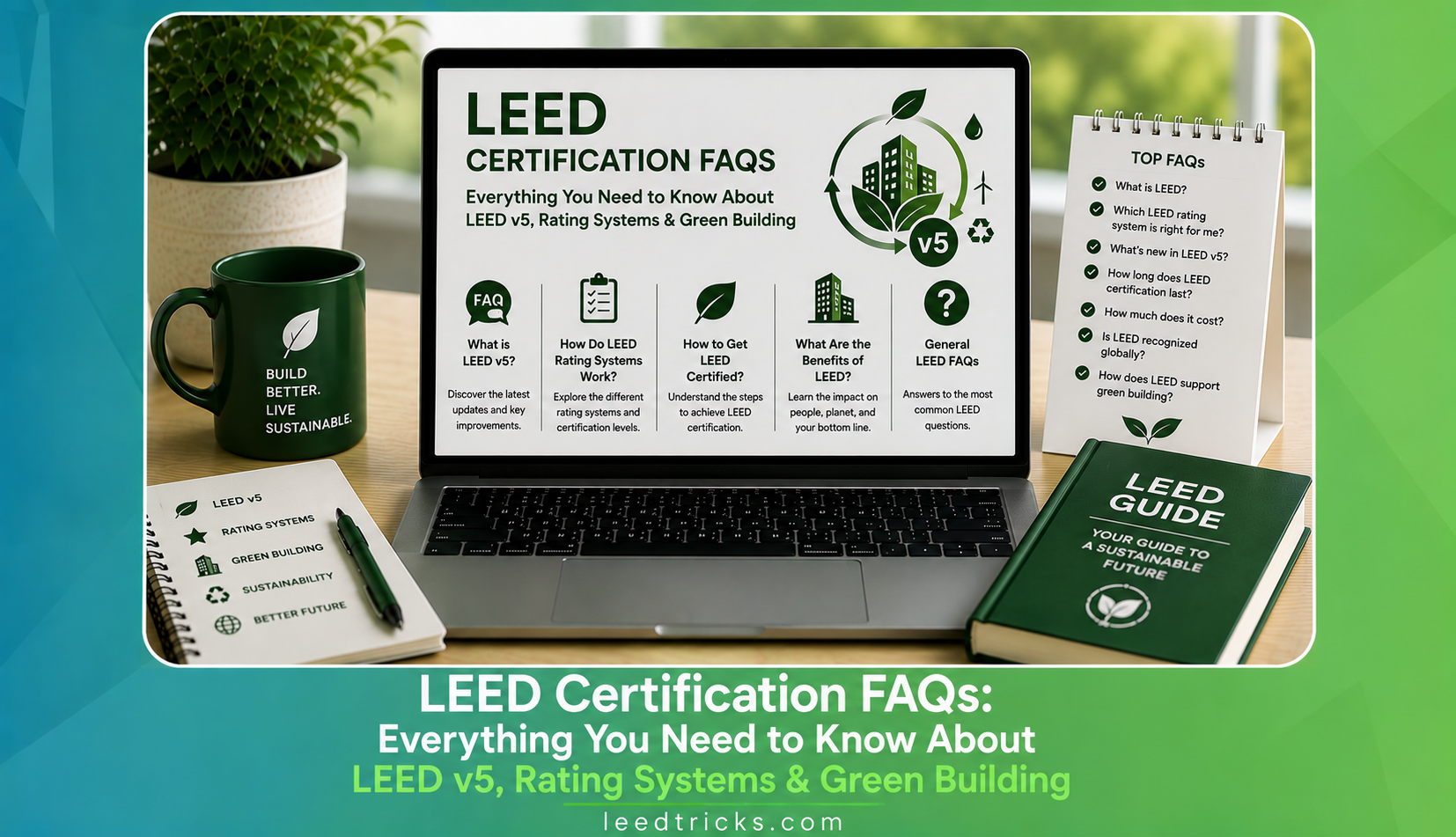
LEED Certification FAQs: Everything You Need to Know About LEED v5, Rating Systems & Green Building
Whether you're preparing for the LEED Green Associate exam, working toward LEED AP certification, or simply exploring sustainable building practices, you likely have several questions about the LEED rating system and its latest updates. Understanding how LEED works, what has changed in LEED v5, and how products and projects contribute to certification is essential for architects, engineers, sustainability professionals, and building owners alike.
In this FAQ section, we've answered some of the most common questions about LEED certification, LEED v5, and the certification process. These concise, evidence-based answers will help you gain a clearer understanding of the world's most recognized green building rating system and stay up to date with the latest developments in sustainable construction.
How does a product contribute towards LEED certification?
A product does not earn LEED certification on its own, as LEED certifies entire buildings rather than individual products. However, carefully selected products can make a significant contribution to earning LEED credits by helping project teams meet the requirements of specific credit categories.
Most product contributions fall within the Materials and Resources (MR) and Indoor Environmental Quality (EQ) categories. Products that provide transparent environmental documentation, such as Environmental Product Declarations (EPDs), Health Product Declarations (HPDs), or responsible material sourcing certifications, can support Material & Resources credits. Similarly, low-emitting products that improve indoor air quality may contribute to Indoor Environmental Quality credits.
In addition, products that improve energy efficiency, conserve water, reduce carbon emissions, enhance durability, or support occupant health can indirectly help projects achieve credits across several LEED categories. The final contribution of any product depends on the project's overall sustainability strategy, the applicable LEED rating system, and the documentation provided by the manufacturer. Project teams evaluate products collectively to determine compliance with LEED credit requirements rather than relying on a single product to earn certification.
Key takeaway: A product supports LEED certification by helping a project satisfy specific sustainability requirements and documentation criteria, but no individual product can be LEED certified or guarantee LEED points on its own.
What is the LEED rating system?
The LEED (Leadership in Energy and Environmental Design) rating system is the world's leading green building certification framework developed by the U.S. Green Building Council (USGBC). It provides a comprehensive set of standards for designing, constructing, operating, and maintaining environmentally responsible buildings that improve energy efficiency, water conservation, indoor environmental quality, and overall sustainability.
LEED evaluates projects across several sustainability categories, including Location and Transportation (LT), Sustainable Sites (SS), Water Efficiency (WE), Energy and Atmosphere (EA), Materials and Resources (MR), Indoor Environmental Quality (EQ), Innovation (IN), and Regional Priority (RP). Projects earn points by meeting specific prerequisites and optional credits, and the total number of points determines the certification level: Certified, Silver, Gold, or Platinum.
The LEED rating system applies to a wide variety of project types, including new construction, commercial buildings, schools, hospitals, residential buildings, interiors, existing buildings, and neighborhood developments. Its goal is to encourage healthier, more energy-efficient, and environmentally sustainable buildings while reducing operating costs and carbon emissions.
What is the difference between LEED v4.1 and v5?
LEED v5 is the newest evolution of the LEED rating system, building upon the foundation established by LEED v4.1 while placing a much stronger emphasis on decarbonization, climate resilience, human health, and social equity.
The most significant difference is that LEED v5 prioritizes reducing operational and embodied carbon throughout a building's entire life cycle. While LEED v4.1 focused primarily on improving building performance and energy efficiency, LEED v5 expands its scope by encouraging projects to address climate action, resilience against environmental risks, biodiversity, and equitable community development.
Another key difference is the updated credit structure. LEED v5 introduces new requirements and revised scoring that better align with global climate goals and modern sustainability practices. Greater importance is placed on carbon reduction strategies, renewable energy adoption, lifecycle assessment, and transparent environmental reporting.
Additionally, LEED v5 enhances guidance for existing buildings by encouraging continuous performance monitoring using real operational data rather than relying primarily on design intentions. It also strengthens requirements related to occupant well-being, environmental justice, and long-term building resilience.
In summary:
|
LEED v4.1 |
LEED v5 |
|
Focuses on improving building performance and operational efficiency |
Focuses on decarbonization, resilience, health, and equity |
|
Strong emphasis on energy, water, and materials optimization |
Strong emphasis on carbon reduction across the building life cycle |
|
Performance-based updates to LEED v4 |
Comprehensive modernization aligned with global climate goals |
|
Encourages sustainability best practices |
Integrates climate action, resilience, biodiversity, and social impact into certification |
Overall, LEED v5 represents a major step forward, helping buildings move beyond traditional sustainability by addressing the urgent challenges of climate change while creating healthier, more resilient, and more equitable built environments.
Yes. LEED v5 has been officially released.
The U.S. Green Building Council (USGBC) officially launched LEED v5 on April 28, 2025, making it the latest version of the world's leading green building rating system. LEED v5 introduces a stronger focus on decarbonization, climate resilience, human health, ecological conservation, and social equity, reflecting the evolving priorities of the built environment.
As of 2026, LEED v5 is available for:
- Building Design and Construction (BD+C)
- Interior Design and Construction (ID+C)
- Operations and Maintenance (O+M)
USGBC has also established a transition timeline:
- Starting July 1, 2026, LEED v5 becomes the only version available for new registrations for the commercial BD+C, ID+C, and O+M rating systems.
- Starting July 1, 2027, LEED v5 will be the standard version for new commercial projects, with only limited exceptions.
Is LEED v5 released?
Yes. LEED v5 was officially released by the U.S. Green Building Council (USGBC) on April 28, 2025. It is the latest version of the LEED green building rating system and introduces significant updates focused on carbon reduction, resilience, occupant well-being, and ecological conservation. LEED v5 is now available for Building Design and Construction (BD+C), Interior Design and Construction (ID+C), and Operations and Maintenance (O+M), and is gradually replacing LEED v4.1 for new project registrations.
Latest posts
Copyright | LEED-Tricks All Rights Reserved . Made with MiskIts