LEED AP Exam Questions : Complete Guide to Practice Questions and Exam Preparation
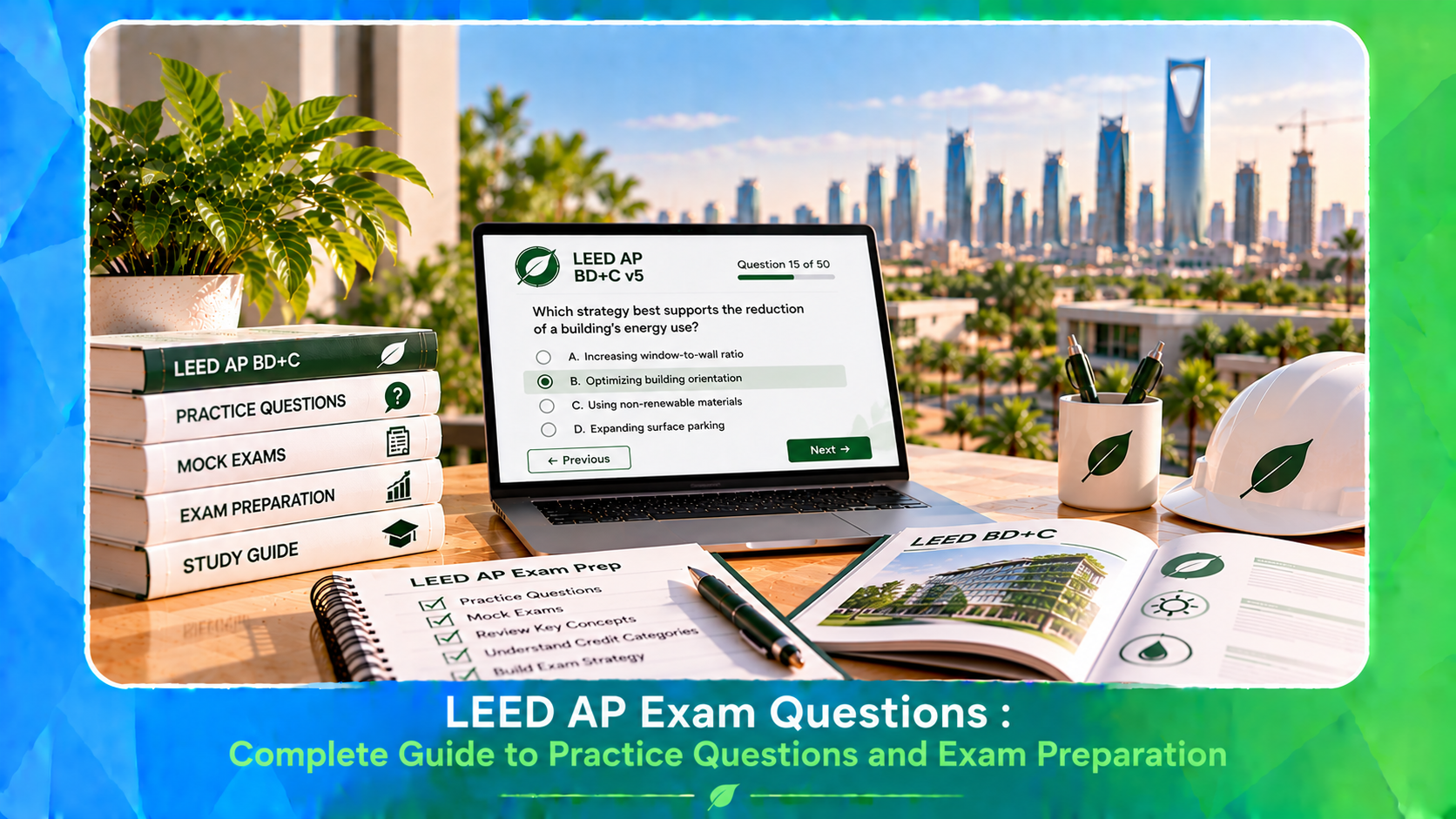
LEED AP Exam Questions : Complete Guide to Practice Questions and Exam Preparation
Preparing for a professional LEED credential requires more than reading a study guide and memorizing definitions. Candidates need to understand how LEED concepts are applied to real building projects, recognize the logic behind different strategies, and become comfortable analyzing scenario-based questions under time pressure. This is why LEED AP Exam Questions play such an important role in effective exam preparation.
Whether you are preparing for the LEED AP BD+C exam, starting your journey toward LEED AP Certification, or looking for realistic practice materials before scheduling your exam, working with high-quality questions can significantly improve your preparation. The right questions do more than test what you already know. They reveal knowledge gaps, strengthen decision-making skills, improve time management, and help you become familiar with the style of questions you may encounter during the examination.
Many candidates make the mistake of treating practice questions as a final revision tool. They study the entire LEED rating system first and only begin practicing shortly before the exam. A more effective approach is to introduce questions throughout the preparation process. Studying a topic and then immediately answering related questions allows you to identify whether you truly understand the concept or simply recognize the terminology.
In this guide, we will explain how to use LEED AP Exam Questions effectively, what makes a good practice question, how scenario-based questions should be analyzed, how to use LEED AP Practice Tests and LEED AP Mock Exams, and how to turn incorrect answers into opportunities for improvement. You will also learn how to build a practical preparation strategy that helps you approach the LEED AP exam with greater confidence.
What Are LEED AP Exam Questions and Why Do They Matter?
LEED AP Exam Questions are practice questions designed to help candidates prepare for the professional LEED AP examination by testing their understanding of sustainable building concepts, LEED requirements, project strategies, and practical decision-making. Their value goes beyond simply checking whether a candidate remembers a definition. High-quality questions encourage candidates to apply what they have learned to situations that resemble decisions made during an actual LEED project.
This distinction is important because professional LEED exams require more than passive knowledge. A candidate may understand what a particular credit is designed to achieve but still struggle when asked to determine which strategy would be most appropriate for a specific project scenario. Practice questions help bridge this gap between theoretical knowledge and practical application.
Regular practice also creates a feedback loop. When you answer a question incorrectly, you have an opportunity to identify the exact concept that needs further study. When you answer correctly, reviewing the explanation can confirm whether you understood the reasoning or simply selected the right option by elimination or intuition.
Another important benefit is familiarity. Candidates who rarely practice questions may spend too much time reading each scenario during the actual exam. Regular exposure helps you recognize common question structures, identify important details, eliminate unlikely options, and make decisions more efficiently.
For this reason, LEED AP Exam Questions should not be treated as an optional addition to your study plan. They should be integrated into your preparation from the beginning and used alongside a reliable LEED AP Study Guide, structured training, and comprehensive review.
What Topics Are Covered in LEED AP Exam Questions?
The topics covered by LEED AP Exam Questions depend on the credential and exam version you are preparing for. Candidates pursuing the BD+C credential should develop a broad understanding of the LEED rating system and how sustainability strategies are integrated throughout the building design and construction process.
Practice questions may address subjects related to integrative planning, site selection, transportation, sustainable sites, water efficiency, energy performance, materials and resources, indoor environmental quality, innovation, and regional priorities. However, studying these areas as completely separate subjects can make preparation more difficult because real projects rarely treat them as isolated categories.
For example, a design decision intended to improve energy performance may influence thermal comfort and indoor environmental quality. A material selection may affect environmental impact, resource efficiency, and occupant health. Similarly, a site strategy can influence transportation patterns, stormwater management, and overall project performance.
This is why effective LEED AP BD+C Exam Questions should encourage candidates to connect multiple concepts rather than memorize isolated facts. When reviewing practice questions, ask yourself which LEED goals are being addressed, what project constraints exist, and why one answer represents a stronger strategy than the alternatives.
Candidates should also make sure their study materials correspond to the exam they intend to take. LEED requirements and priorities can evolve, so relying on outdated practice questions can create confusion and potentially reinforce incorrect assumptions. A strong preparation program should use current resources and clearly explain the context behind each answer.
LEED AP BD+C Exam Questions and Scenario-Based Problems
One of the most important skills candidates can develop is the ability to solve scenario-based questions. Instead of asking for a simple fact, a scenario may describe a building, project team, design challenge, or sustainability objective and then ask you to determine the most appropriate action.
The first step is to read the entire scenario carefully. Avoid jumping immediately to the answer choices. Important information may appear toward the end of the question and can completely change the correct response. Identify the project objective first, then determine what the question is actually asking you to accomplish.
Next, evaluate each answer according to the scenario rather than according to general knowledge. Several options may sound reasonable, but the correct choice should provide the strongest alignment with the stated project objective and applicable LEED principles.
For example, if a question describes a project attempting to reduce water consumption, do not automatically choose the option that sounds most environmentally friendly. Instead, determine what type of water use the question is addressing, what project conditions are provided, and which strategy directly responds to the stated objective.
This analytical approach is especially important when working through LEED AP BD+C Exam Questions. Candidates should train themselves to identify the relationship between the project goal and the proposed strategy.
The more scenario-based questions you solve, the easier it becomes to distinguish between answers that are technically possible and the answer that represents the best decision within the context provided.
How to Use LEED AP Practice Tests Effectively
A LEED AP Practice Test can be one of the most valuable tools in your preparation, but only when used correctly. Simply completing a practice test and looking at the final score does not provide enough information to improve your performance.
Before starting a practice test, create conditions that resemble the real examination as closely as possible. Set aside uninterrupted time, avoid checking notes during the test, and use a timer. This helps you evaluate not only your knowledge but also your ability to make decisions under time pressure.
Once you finish, review the results carefully. Separate your questions into three categories: incorrect answers, correct answers you were uncertain about, and correct answers you understood confidently. The first two categories deserve additional review.
For every incorrect answer, write down why you selected it and why the correct answer was better. This simple habit can reveal patterns in your mistakes. Perhaps you are misunderstanding certain concepts, rushing through scenarios, confusing similar terms, or failing to identify the main objective of a question.
Use the results to adjust your study plan. If a practice test reveals consistent weaknesses in one knowledge area, return to your study guide and review that topic before taking another full-length test.
The purpose of a LEED AP Practice Test is not to prove that you already know everything. Its purpose is to show you exactly what you need to improve before the official exam.
LEED AP Mock Exam vs Practice Test: What Is the Difference?
Although the terms LEED AP Practice Test and LEED AP Mock Exam are often used interchangeably, they can serve different purposes within a preparation strategy.
Practice tests are particularly useful during the learning stage. You can use them after studying specific topics to evaluate your understanding and identify weaknesses. Topic-specific practice questions are especially helpful because they allow you to focus on one subject at a time and immediately reinforce what you have learned.
A mock exam, on the other hand, is most valuable when you are approaching the final stages of preparation. A realistic LEED AP Mock Exam should simulate the actual testing experience as closely as possible. Instead of studying one topic at a time, you should encounter questions covering different concepts and difficulty levels.
Mock exams are also valuable for developing time-management skills. Candidates sometimes discover that they know the material but spend too much time analyzing difficult questions. Practicing under timed conditions helps you develop a rhythm that allows you to maintain accuracy without sacrificing speed.
A good preparation strategy uses both tools at different stages. Start with topic-based LEED AP Exam Questions, progress to comprehensive practice tests, and finish with realistic mock exams.
This progression allows you to move from learning and understanding to applying and finally performing under realistic examination conditions.
How Many LEED AP Exam Questions Should You Practice?
There is no universal number of questions that guarantees success. Completing thousands of low-quality questions will not necessarily make you better prepared than completing several hundred carefully designed questions and thoroughly reviewing your mistakes.
The quality of the question matters more than the number. A useful practice question should test an important concept, provide realistic context, include plausible answer choices, and explain why the correct answer is the best option.
Instead of setting a target such as "I need to complete 1,000 questions," create performance-based goals. For example, you might begin by answering topic-specific questions after each study session. As your knowledge improves, introduce mixed-topic practice tests and eventually complete full-length mock exams.
Your results should determine when you move from one stage to another. If you are consistently struggling with a particular topic, more questions alone may not solve the problem. Return to the underlying concept, review the study material, and then test yourself again.
The goal is to reach a level where you can consistently analyze unfamiliar scenarios, eliminate weak answer choices, and select the best answer without relying heavily on guessing.
Therefore, rather than asking how many LEED AP Exam Questions you need to solve, ask whether each question is helping you understand the LEED concepts more deeply.
How to Analyze Your Wrong Answers
One of the most powerful preparation techniques is learning from incorrect answers. A wrong answer should never be treated simply as a lost point. It should be treated as evidence showing you where your preparation needs improvement.
Create an error log while studying. For each incorrect question, record the topic, your selected answer, the correct answer, and the reason you made the mistake. Then categorize the mistake.
Some errors come from knowledge gaps. Others happen because the candidate misunderstood the question, overlooked a key detail, confused two similar concepts, or rushed because of time pressure.
Once you identify the pattern, you can take targeted action. If most of your mistakes come from one topic, dedicate additional study time to that area. If your mistakes are mainly caused by misreading questions, practice slowing down and identifying the exact requirement before looking at the answer choices.
This process transforms LEED AP Exam Questions into a personalized study tool. Instead of repeatedly reviewing everything, you focus your time on the areas that are actually limiting your performance.
Your error log can also become one of your most valuable resources during the final week before the exam. Rather than rereading hundreds of pages, you can review the concepts that previously caused difficulty and confirm that you now understand them.
How to Prepare for LEED AP BD+C Exam Questions
Effective preparation combines knowledge acquisition with continuous application. Start by choosing a current and reliable LEED AP Study Guide that matches your exam requirements. Build your understanding of the major concepts before attempting to memorize detailed information.
Once you understand a topic, immediately apply it through practice questions. This creates a connection between theory and decision-making. If you are studying water efficiency, for example, follow the lesson with questions that require you to evaluate water-related strategies in project scenarios.
As your preparation progresses, begin mixing topics. This is important because the actual exam will not tell you which category a question belongs to before you answer it. Mixed practice forces you to identify the relevant concept independently.
You should also incorporate LEED AP Exam Preparation into your weekly schedule rather than treating it as something that happens only near exam day. Consistent short study sessions are generally easier to maintain and provide more opportunities for repetition and reinforcement.
A structured LEED AP Course can also help candidates who prefer guided learning. Professional training can organize complex information, explain difficult concepts, provide realistic questions, and reduce the amount of time spent searching for reliable study materials.
The ultimate goal is to move through three stages: understand the concept, apply the concept, and confidently analyze unfamiliar scenarios.
Common Mistakes When Answering LEED AP Exam Questions
Many candidates make the same mistakes when practicing LEED AP Exam Questions, and recognizing them early can save significant preparation time.
One common mistake is reading only part of the scenario. Candidates sometimes see a familiar keyword and immediately select an answer without understanding the full context. Another mistake is choosing the answer that sounds the most environmentally friendly without considering the specific objective presented in the question.
Overthinking is another problem. While careful analysis is important, spending several minutes on a single question can create unnecessary time pressure later. Candidates should learn to identify when they have enough information to make a decision and move forward.
Memorization without understanding is also a major weakness. A candidate may remember a definition but still struggle to apply it to a project scenario. This is why practice questions should always be accompanied by explanations and conceptual review.
Finally, some candidates never analyze their mistakes. They complete one test after another and focus only on improving their score. Without understanding why previous answers were wrong, however, the same mistakes are likely to appear again.
Effective preparation requires continuous feedback. Every question should teach you something, whether your answer was correct or incorrect.
LEED AP Exam Tips for Answering Difficult Questions
When facing a difficult LEED AP Exam Question, begin by identifying the primary objective. Ask yourself what the question is actually testing. This prevents unnecessary distraction from secondary information included in the scenario.
Next, eliminate answers that clearly conflict with the project's objective. Even when you are uncertain about the final choice, eliminating two or three weak options can significantly improve your chances.
Pay close attention to words that define the scenario. Terms such as "most appropriate," "best strategy," "primary objective," or "first step" indicate that the question is asking you to prioritize among several possible actions.
Avoid changing your answer repeatedly without a clear reason. Your initial choice may be based on a correct understanding of the scenario, and unnecessary second-guessing can introduce mistakes.
Time management is equally important. If you encounter a question that requires excessive analysis, mark it and continue. Returning to it later allows you to protect the time needed for questions you can answer confidently.
The most effective LEED AP Exam Tips are not shortcuts. They are habits that help you apply your knowledge accurately and efficiently.
How to Choose the Best LEED AP Study Guide
A quality LEED AP Study Guide should do more than summarize terminology. It should help you understand the reasoning behind LEED requirements and prepare you to apply that knowledge to realistic scenarios.
Look for resources that are clearly aligned with the credential and exam you are preparing for. The material should be current, logically organized, and supported by explanations rather than lists of memorization points.
Practice questions should also be included or used alongside the study guide. A resource that explains concepts without allowing you to test your understanding leaves a major gap in preparation.
Candidates should also avoid relying exclusively on unofficial summaries found online. Free resources can be useful for supplementary learning, but your primary preparation should be based on reliable and current materials.
A strong study guide should ultimately help you answer three questions for every major topic: What does this concept mean? Why does it matter? And how would I apply it in a real project?
If your study material can answer those questions, you are developing the type of understanding needed for the professional LEED AP examination.
How LEED AP Training Can Improve Your Exam Performance
Structured LEED AP Training can make the preparation process more efficient by giving candidates a clear learning path instead of requiring them to organize everything independently.
A professional training program can break complex LEED concepts into manageable lessons, explain relationships between different categories, and demonstrate how to approach difficult scenarios. This is particularly useful for candidates who have professional experience in construction or engineering but limited experience with the LEED rating system.
Training also provides an opportunity to practice with structured LEED AP Exam Questions and receive explanations for challenging concepts. Instead of spending hours searching multiple websites for answers, candidates can follow a focused curriculum designed around their certification goals.
For professionals preparing for the BD+C credential, specialized LEED AP BD+C Training can also provide context that connects exam preparation with real project applications. This makes the knowledge more valuable beyond the examination itself.
The right training program should not promise shortcuts or guaranteed results. Instead, it should give candidates the knowledge, resources, practice opportunities, and guidance required to prepare effectively.
How to Know When You Are Ready for the LEED AP Exam
Knowing when to schedule your exam is an important part of preparation. Some candidates schedule too early because they feel pressured to finish quickly, while others continue studying indefinitely because they never feel completely confident.
Your readiness should be based on measurable performance rather than emotion alone. You should be able to consistently perform well on comprehensive LEED AP Practice Tests, understand why your answers are correct, and explain the reasoning behind your choices.
You should also be comfortable with scenario-based questions and capable of managing your time without becoming overwhelmed. If your scores are improving consistently and your mistakes are becoming less frequent, you are likely moving toward exam readiness.
Pay particular attention to your weak areas. A high overall score can sometimes hide significant gaps in one category. Review those areas before scheduling the exam and make sure your knowledge is balanced.
Most importantly, do not measure readiness solely by the number of questions you have completed. Measure it by your ability to apply LEED concepts to unfamiliar situations.
Final Preparation Strategy for LEED AP Exam Questions
The final stage of preparation should bring everything together. At this point, you should already understand the major LEED concepts, have experience answering topic-specific questions, and have completed several comprehensive practice sessions.
Use your final days to review your error log, revisit difficult concepts, and complete a realistic LEED AP Mock Exam under timed conditions. Avoid trying to learn large amounts of new material immediately before the exam.
Focus on consistency. You want to enter the exam knowing how to read a scenario, identify its objective, eliminate weak answers, select the best option, and manage your time.
Remember that the purpose of LEED AP Exam Questions is not simply to predict the exact questions you will see on exam day. Their real value is teaching you how to think, analyze, and apply LEED knowledge under pressure.
When you combine a reliable LEED AP Study Guide, structured LEED AP Exam Preparation, targeted practice questions, and realistic mock exams, you create a preparation system that supports both confidence and competence.
Why Choose LEED Tricks for LEED AP Exam Preparation?
At LEED Tricks, exam preparation is built around practical understanding rather than memorization alone. Our goal is to help professionals develop the knowledge and analytical skills they need to approach LEED certification with confidence.
Our training resources are designed to support candidates through different stages of preparation, from understanding fundamental concepts to practicing with realistic LEED AP Exam Questions, LEED AP Practice Tests, and LEED AP Mock Exams.
Whether you are preparing for the LEED AP BD+C credential, strengthening your knowledge of sustainable building practices, or looking for structured LEED AP Training, LEED Tricks provides focused educational resources designed around the needs of modern sustainability professionals.
Start your preparation with the right strategy, practice consistently, review your mistakes, and build the confidence needed to take the next step toward LEED AP Certification.
Frequently Asked Questions About LEED AP Exam Questions
Are LEED AP Exam Questions difficult?
The difficulty depends on your level of preparation and familiarity with scenario-based questions. Candidates who understand the concepts and practice regularly are generally better prepared to analyze challenging questions.
Where can I find LEED AP Practice Tests?
Candidates can use professional LEED preparation platforms that provide structured practice tests and mock exams designed around the credential they are pursuing. Always verify that your study resources are current and relevant to your exam.
Are LEED AP Mock Exams useful?
Yes. A realistic LEED AP Mock Exam can help you evaluate your overall readiness, improve time management, identify weak areas, and become familiar with the pressure of completing a full examination.
How should I study for the LEED AP Exam?
Combine a reliable LEED AP Study Guide with structured training, topic-based questions, comprehensive practice tests, and full mock exams. Review your incorrect answers carefully and focus additional study time on weak areas.
How many LEED AP Exam Questions should I practice?
There is no specific number that guarantees success. Focus on high-quality questions and make sure you understand the reasoning behind each answer rather than simply trying to complete the largest possible number.
What is the best LEED AP Study Guide?
The best study guide is one that is current, clearly organized, aligned with your credential, and focused on both conceptual understanding and practical application. It should be used alongside practice questions rather than as your only preparation resource.
How can I improve my LEED AP exam score?
Analyze every practice test carefully, identify recurring mistakes, review weak topics, and continue practicing scenario-based questions. Improving the quality of your preparation is more valuable than simply increasing the number of questions you complete.
Are LEED AP BD+C Exam Questions scenario-based?
Many professional certification questions require candidates to apply knowledge to project situations. Developing strong scenario-analysis skills is therefore an important part of preparing for the LEED AP BD+C examination.
Final Takeaway
Preparing with LEED AP Exam Questions is one of the most effective ways to transform theoretical LEED knowledge into practical exam readiness. The goal is not to memorize a collection of answers. It is to understand the principles behind those answers and develop the ability to apply LEED concepts when faced with unfamiliar project scenarios.
Build your preparation around a current LEED AP Study Guide, structured LEED AP Exam Preparation, high-quality LEED AP Practice Tests, and realistic LEED AP Mock Exams. Most importantly, learn from your mistakes and continuously refine your approach.
With the right preparation strategy and consistent practice, you can approach your LEED AP exam with greater confidence and a stronger understanding of sustainable building principles.
Latest posts
Copyright | LEED-Tricks All Rights Reserved . Made with MiskIts