LEED AP Exam Questions: Complete Practice Guide with Sample Questions and Expert Preparation Tips
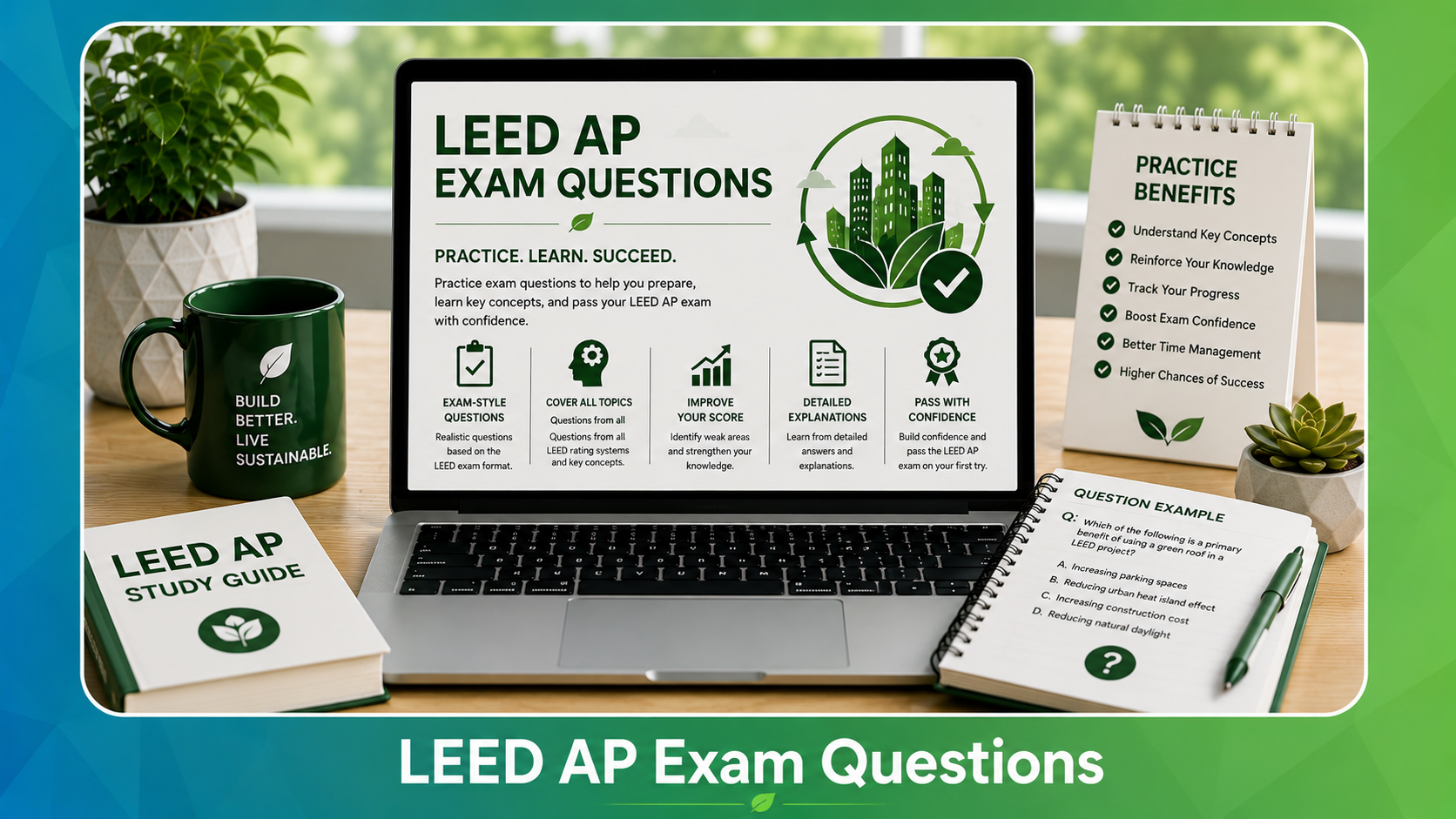
LEED AP Exam Questions: Complete Practice Guide with Sample Questions and Expert Preparation Tips
Preparing for the LEED AP Exam is about much more than reading study materials or memorizing technical definitions. The certification exam is specifically designed to evaluate your ability to apply sustainable building principles to real-world scenarios, making practical preparation one of the most important factors in achieving a passing score. This is why candidates searching for LEED AP Exam Questions are often looking for more than simple practice quizzes—they want to understand how questions are structured, what concepts are tested most frequently, and how to think like a LEED professional during the examination.
Whether you are preparing for the LEED AP BD+C Exam, reviewing a LEED AP Study Guide, or taking a professional LEED AP Course, practicing realistic exam questions should become a central part of your study strategy. Every question you answer strengthens your understanding of the LEED rating system, improves your analytical thinking, and prepares you to make better decisions under timed exam conditions.
Modern LEED examinations focus heavily on integrated project delivery, sustainable design strategies, energy performance, material selection, indoor environmental quality, and project documentation. Rather than asking isolated factual questions, candidates are expected to evaluate project situations and choose the solution that best satisfies LEED requirements while supporting environmental performance and project goals.
In this comprehensive guide, you'll discover how LEED AP Exam Questions are written, the different question formats you should expect, the topics most frequently covered in the exam, practical preparation strategies, realistic sample questions with explanations, and expert recommendations that will help you build confidence before test day. By the end of this guide, you'll understand how to transform practice questions into one of your strongest preparation tools.
What Are LEED AP Exam Questions?
The LEED AP Exam is designed to measure professional competency rather than theoretical knowledge alone. As a result, LEED AP Exam Questions are carefully developed to assess your ability to interpret project information, evaluate sustainable design strategies, and make informed decisions based on the LEED rating system. Instead of asking candidates to simply remember terminology, the examination emphasizes practical application across every phase of a building project.
Most questions present situations that architects, engineers, sustainability consultants, and construction professionals encounter during real projects. Candidates may be asked to determine the most appropriate sustainability strategy, identify the correct documentation process, prioritize environmental objectives, or recommend design solutions that maximize LEED certification opportunities.
Because the examination evaluates professional judgment, many questions contain multiple answers that appear reasonable at first glance. Success depends on understanding which option best aligns with LEED requirements rather than selecting an answer based on personal opinion or general engineering knowledge. This distinction explains why candidates who rely exclusively on memorization often struggle despite spending many hours studying.
Another important characteristic of LEED AP Practice Questions is their integration of multiple concepts within a single scenario. A question involving energy efficiency may also require knowledge of integrated project planning, material selection, or indoor environmental quality. Developing this broader understanding allows candidates to approach complex questions with greater confidence and accuracy.
Ultimately, practice questions should not be viewed simply as assessment tools. They are learning opportunities that help candidates strengthen critical thinking, improve decision-making, and develop the analytical mindset expected from professionals working on LEED-certified projects.
Types of LEED AP Exam Questions
Understanding the different types of LEED AP Exam Questions is one of the most effective ways to improve your preparation. Although every examination is unique, most questions fall into several recognizable categories, each designed to evaluate a specific aspect of your knowledge and professional judgment.
The most common type is the scenario-based question. These questions describe realistic project situations involving clients, architects, contractors, engineers, or project teams. Candidates must analyze the information provided and determine which action best supports LEED requirements. Scenario questions often require integrating knowledge from multiple credit categories, making them more challenging than straightforward factual questions.
Another common format includes conceptual questions, which test your understanding of sustainability principles and LEED terminology. Rather than asking for definitions directly, these questions evaluate whether you understand why specific strategies improve environmental performance and how they contribute to certification success.
Some examinations also include project team questions, focusing on collaboration, communication, and the responsibilities of different stakeholders throughout the design and construction process. Understanding integrated project delivery is essential because LEED emphasizes teamwork from the earliest planning stages.
Candidates should also expect documentation questions, which assess their knowledge of LEED submission requirements, project documentation procedures, and certification workflows. Since accurate documentation plays a critical role in achieving certification, these questions evaluate practical administrative knowledge in addition to technical expertise.
Finally, certain questions require candidates to interpret project priorities and recommend the most effective sustainable solution based on cost, environmental impact, and certification objectives. These decision-making questions closely resemble the challenges professionals encounter throughout real LEED-certified projects.
LEED AP Exam Question Format
Although many candidates expect a traditional multiple-choice examination, the LEED AP Exam uses carefully structured question formats that encourage critical thinking rather than memorization. Understanding these formats before exam day helps reduce anxiety and improves overall performance.
Most LEED AP Exam Questions are presented as single-answer multiple-choice questions with four possible responses. While this format appears straightforward, the distractor answers are intentionally written to reflect realistic project decisions. Candidates must identify the option that best satisfies LEED requirements rather than simply choosing an answer that appears technically acceptable.
Scenario-based questions typically begin with a project description followed by a specific challenge facing the design team. Additional information may include project location, client objectives, sustainability goals, or construction constraints. Candidates are expected to analyze every detail before selecting the most appropriate response.
Some questions are intentionally designed to test prioritization rather than factual recall. Instead of asking what a particular LEED credit means, the examination may ask which action should be completed first or which strategy provides the greatest environmental benefit within the context of a particular project.
Because every question contributes to evaluating professional competency, candidates should avoid rushing through the examination. Reading carefully, identifying key project objectives, and eliminating incorrect options systematically often produces better results than relying on instinct alone.
LEED AP Sample Questions with Detailed Explanations
One of the most effective ways to prepare for the LEED AP Exam is by practicing realistic questions that reflect the style and critical thinking required during the official examination. While no practice question can exactly replicate the actual exam, well-designed examples help candidates understand how LEED concepts are applied in real project situations.
The following sample questions are designed to strengthen analytical thinking rather than memorization. After answering each question, review the explanation carefully—even if you selected the correct answer. Understanding why an answer is correct is just as important as getting it right.
Sample Question 1
A project team wants to maximize energy efficiency during the earliest stages of design. Which strategy is most likely to improve the project's overall LEED performance?
A. Select interior finishes before developing the energy model.
B. Delay sustainability discussions until construction begins.
C. Conduct an integrated design workshop involving all major project stakeholders.
D. Focus exclusively on renewable energy systems after construction documents are completed.
Correct Answer
C. Conduct an integrated design workshop involving all major project stakeholders.
Explanation
Integrated design is one of the core principles of LEED. Bringing architects, engineers, owners, and consultants together early allows the team to optimize building performance before major design decisions are finalized. This collaborative process typically results in higher energy performance, lower lifecycle costs, and greater opportunities for achieving LEED credits.
Sample Question 2
Which LEED credit category primarily focuses on reducing potable water consumption?
A. Sustainable Sites
B. Water Efficiency
C. Innovation
D. Materials and Resources
Correct Answer
B. Water Efficiency
Explanation
The Water Efficiency category encourages strategies that reduce indoor and outdoor water use through efficient fixtures, irrigation reduction, water reuse, and responsible management of water resources.
Sample Question 3
A client wants to improve indoor occupant health while pursuing LEED certification. Which strategy provides the greatest direct benefit?
A. Increasing parking capacity
B. Installing low-emitting materials
C. Expanding the building footprint
D. Using conventional lighting throughout the building
Correct Answer
B. Installing low-emitting materials
Explanation
Low-emitting materials improve indoor air quality by reducing volatile organic compounds (VOCs), directly supporting occupant health and contributing to Indoor Environmental Quality credits.
Sample Question 4
When should sustainability goals ideally be established during a LEED project?
A. After construction is complete
B. During the commissioning phase
C. At the earliest stages of project planning
D. After submitting documentation
Correct Answer
C. At the earliest stages of project planning.
Explanation
Early planning allows the project team to integrate sustainability into every design decision instead of adding LEED strategies later, when changes become more expensive and less effective.
Sample Question 5
Which professional is primarily responsible for coordinating multiple disciplines throughout a LEED project?
A. The integrated project team
B. The building owner alone
C. The general contractor only
D. The furniture supplier
Correct Answer
A. The integrated project team.
Explanation
LEED emphasizes collaboration. Successful certification depends on continuous communication between architects, engineers, contractors, consultants, and owners rather than relying on a single stakeholder.
Sample Question 6
A project is evaluating construction materials. Which option best supports LEED sustainability goals?
A. Materials with unknown environmental impacts
B. Materials transported long distances without evaluation
C. Products with verified environmental transparency and responsible sourcing
D. Materials selected only because they have the lowest purchase price
Correct Answer
C. Products with verified environmental transparency and responsible sourcing.
Explanation
LEED encourages responsible material selection through environmental product declarations, responsible sourcing, transparency, and lifecycle considerations—not simply the lowest initial cost.
Sample Question 7
Why is building commissioning important in LEED-certified projects?
A. It replaces energy modeling.
B. It verifies that building systems operate as intended.
C. It eliminates construction documentation.
D. It reduces project size.
Correct Answer
B. It verifies that building systems operate as intended.
Explanation
Commissioning ensures that HVAC, lighting, water systems, and other building systems perform according to the owner's project requirements and design intent.
Sample Question 8
Which project strategy contributes most directly to reducing operational carbon emissions?
A. Increasing decorative landscaping
B. Improving building energy performance
C. Adding additional parking spaces
D. Expanding building height
Correct Answer
B. Improving building energy performance.
Explanation
Operational carbon is largely influenced by building energy consumption. High-performance building systems, efficient envelopes, and optimized HVAC design significantly reduce emissions.
Sample Question 9
A LEED project team is reviewing documentation before submission. What is the primary objective?
A. Increase construction costs
B. Demonstrate compliance with LEED credit requirements
C. Reduce project scheduling
D. Eliminate commissioning activities
Correct Answer
B. Demonstrate compliance with LEED credit requirements.
Explanation
Documentation serves as evidence that project strategies satisfy LEED requirements and support certification review.
Sample Question 10
Which study method generally produces the highest success rate for the LEED AP Exam?
A. Memorizing credit names only
B. Reading one textbook repeatedly
C. Combining structured study, practice questions, and mock exams
D. Studying only during the final weekend
Correct Answer
C. Combining structured study, practice questions, and mock exams.
Explanation
Successful candidates typically combine an updated LEED AP Study Guide, professional LEED AP Training, realistic LEED AP Practice Questions, and multiple LEED AP Mock Exams to build both knowledge and exam confidence.
Common Topics Covered in LEED AP Exam Questions
Although every examination is different, certain subjects consistently appear because they represent the core principles of sustainable building design. Understanding these topics helps candidates prioritize their study efforts and prepare more strategically.
The exam frequently includes questions related to Integrative Process, where candidates must understand how early collaboration improves project performance. Sustainable site selection and transportation strategies are also common because location decisions significantly influence environmental outcomes and certification opportunities.
Water conservation remains another major focus area. Candidates should be comfortable evaluating indoor and outdoor water reduction strategies, alternative water sources, and efficient plumbing systems. Similarly, the Energy and Atmosphere category receives substantial attention due to its influence on building performance, carbon reduction, and operational efficiency.
Questions involving Materials and Resources often require candidates to evaluate responsible sourcing, environmental transparency, lifecycle impacts, and waste management practices. Indoor Environmental Quality topics—including ventilation, daylight, thermal comfort, and low-emitting materials—also appear regularly because occupant well-being is central to the LEED rating system.
Finally, candidates should expect questions covering Innovation credits, Regional Priority strategies, project documentation, integrated design, and multidisciplinary collaboration. Since the examination evaluates professional decision-making rather than isolated facts, understanding how these topics interact within complete building projects is essential for success.
How to Practice LEED AP Exam Questions Effectively
Answering dozens of LEED AP Exam Questions is helpful, but simply completing practice questions without a clear strategy rarely leads to significant improvement. Successful candidates approach every practice session as an opportunity to strengthen their understanding of the LEED rating system, identify knowledge gaps, and improve their decision-making under realistic exam conditions.
A productive study routine begins with reviewing one LEED category at a time before attempting related practice questions. For example, after studying Water Efficiency, complete a focused set of questions covering water conservation strategies, indoor plumbing efficiency, outdoor water use, and alternative water sources. This targeted approach reinforces new knowledge while making it easier to identify topics that require additional review.
After completing each set of questions, spend time analyzing every answer—not only the incorrect ones. Understanding why the correct answer is the best choice helps develop the analytical thinking required during the official exam. Many questions include multiple plausible answers, and learning to distinguish the best option is one of the most valuable exam skills.
As your preparation progresses, gradually increase the difficulty of your study sessions. Move from topic-specific quizzes to mixed-question practice tests, then finish your preparation with several full-length LEED AP Mock Exams completed under timed conditions. This progression closely mirrors the learning process experienced by successful candidates and helps build both confidence and consistency before exam day.
Finally, maintain a record of frequently missed topics. Revisiting weak areas every week creates continuous improvement and prevents the same mistakes from appearing repeatedly throughout your preparation.
Common Mistakes Candidates Make During LEED AP Exam Preparation
Even highly motivated professionals sometimes struggle with the LEED AP Exam because they focus on the wrong preparation methods. Understanding the most common mistakes can save valuable study time and significantly improve your chances of success.
One of the biggest errors is relying entirely on memorization. Although learning terminology is important, the examination primarily evaluates your ability to apply sustainable design principles in practical situations. Candidates who memorize definitions without understanding their real-world applications often find scenario-based questions surprisingly difficult.
Another common mistake is using outdated study materials. As the LEED rating system evolves, particularly with LEED AP BD+C V5, older resources may no longer reflect current certification priorities. Always verify that your LEED AP Study Guide and supporting materials are updated to the latest version.
Many candidates also postpone practice exams until the final days before the test. In reality, LEED AP Practice Questions should be incorporated throughout the entire study process. Continuous assessment helps identify weaknesses early enough to correct them before examination day.
Poor time management is another frequent challenge. Some candidates spend too much time analyzing difficult questions while rushing through easier ones later in the exam. Practicing under realistic time constraints develops pacing skills and reduces unnecessary pressure during the official examination.
Finally, studying in isolation without discussing concepts or reviewing explanations can slow progress. Whether through instructor-led LEED AP Training, study groups, or professional mentoring, interacting with experienced professionals often provides valuable insights that accelerate learning.
LEED AP Practice Test vs LEED AP Mock Exam
Although these terms are sometimes used interchangeably, LEED AP Practice Tests and LEED AP Mock Exams serve different purposes during your preparation.
|
LEED AP Practice Test |
LEED AP Mock Exam |
|
Focuses on individual topics or knowledge areas |
Simulates the complete examination experience |
|
Used throughout the study process |
Usually completed during the final preparation stage |
|
Helps reinforce recently studied concepts |
Measures overall exam readiness |
|
Often shorter and topic-specific |
Full-length exam completed under timed conditions |
|
Ideal for identifying weak subject areas |
Ideal for improving confidence and time management |
A balanced preparation strategy should include both. Practice tests strengthen individual concepts, while mock exams evaluate your ability to apply everything you have learned under realistic exam conditions.
Where Can You Find Reliable LEED AP Exam Questions?
Finding reliable LEED AP Exam Questions is just as important as choosing the right study guide. Not every practice resource reflects the style, difficulty, or objectives of the current examination, and relying on low-quality questions can create misunderstandings that affect your performance.
High-quality preparation materials should be developed by professionals with practical LEED experience and should reflect the latest LEED AP BD+C V5 framework. Good practice questions emphasize decision-making, integrated design, sustainability principles, and project-based scenarios rather than isolated factual recall.
Candidates should combine multiple learning resources, including a current LEED AP Study Guide, structured LEED AP Training, topic-based practice quizzes, and realistic mock exams. This combination creates a more comprehensive preparation experience than relying on a single source.
At LEED Tricks, our preparation resources are designed to reflect current industry practices while helping professionals understand the reasoning behind every concept—not simply memorize answers. By combining practical instruction with realistic practice opportunities, candidates can develop the confidence and analytical skills needed for long-term professional success.
Why Choose LEED Tricks for Your LEED AP Exam Preparation?
Preparing for the LEED AP Exam is about building practical expertise—not just passing a certification test. At LEED Tricks, we help professionals develop a deep understanding of sustainable building principles through structured learning, practical case studies, and exam-focused preparation aligned with the latest LEED AP BD+C V5 standards.
Our training programs combine comprehensive study materials, instructor guidance, realistic LEED AP Practice Questions, and full LEED AP Mock Exams to create a complete learning experience. Rather than memorizing isolated facts, learners develop the critical thinking and decision-making skills required for both the certification exam and real-world green building projects.
Whether you are preparing for your first LEED credential or advancing toward LEED AP BD+C Certification, LEED Tricks provides the resources, support, and practical insights needed to help you study with confidence and achieve your professional goals.
Conclusion
Mastering LEED AP Exam Questions is one of the most effective ways to prepare for certification success. Practice questions strengthen technical knowledge, improve analytical thinking, develop confidence, and help candidates become familiar with the decision-making process expected during the official examination.
Rather than relying solely on reading materials, combine a structured LEED AP Study Guide, professional LEED AP Training, regular LEED AP Practice Tests, and realistic LEED AP Mock Exams to create a balanced preparation strategy. This comprehensive approach not only increases your chances of passing the exam on your first attempt but also develops the practical expertise required for a successful career in sustainable design and green building.
If you are ready to take the next step toward earning your LEED AP Certification, explore the professional preparation programs available through LEED Tricks and begin building the knowledge, confidence, and practical skills that today's green building industry demands.
Frequently Asked Questions (FAQ)
What are LEED AP Exam Questions?
They are practice or exam-style questions designed to evaluate your understanding of LEED concepts, sustainable design principles, and real-world project decision-making.
Are LEED AP Exam Questions based on memorization?
No. Most questions focus on applying LEED concepts to realistic scenarios rather than recalling definitions.
How many practice questions should I complete before the exam?
There is no fixed number, but completing several hundred high-quality practice questions across all exam domains is generally recommended.
Are practice questions enough to pass the LEED AP Exam?
No. Practice questions should be combined with a current study guide, structured learning, and full mock exams.
What's the difference between LEED AP Practice Questions and Mock Exams?
Practice questions reinforce individual topics, while mock exams simulate the complete examination experience under timed conditions.
Which topics appear most frequently in LEED AP Exam Questions?
Integrated Process, Energy and Atmosphere, Water Efficiency, Indoor Environmental Quality, Materials and Resources, Sustainable Sites, Innovation, and Regional Priority are among the most commonly tested areas.
Should I study LEED Green Associate materials first?
A solid understanding of LEED fundamentals is highly beneficial before preparing for advanced specialty exams.
How can I improve my score on scenario-based questions?
Focus on understanding the purpose behind each LEED credit, practice interpreting project scenarios, and review detailed explanations after every practice session.
Is LEED AP Certification recognized internationally?
Yes. LEED credentials are respected worldwide across architecture, engineering, construction, and sustainability industries.
Where can I find updated LEED AP practice resources?
Choose professional resources that align with the latest LEED version and include realistic practice questions, study guides, and mock exams.
Latest posts
Copyright | LEED-Tricks All Rights Reserved . Made with MiskIts