LEED AP BD+C V5 Explained: Complete Guide to the Exam, Certification, and Career Path
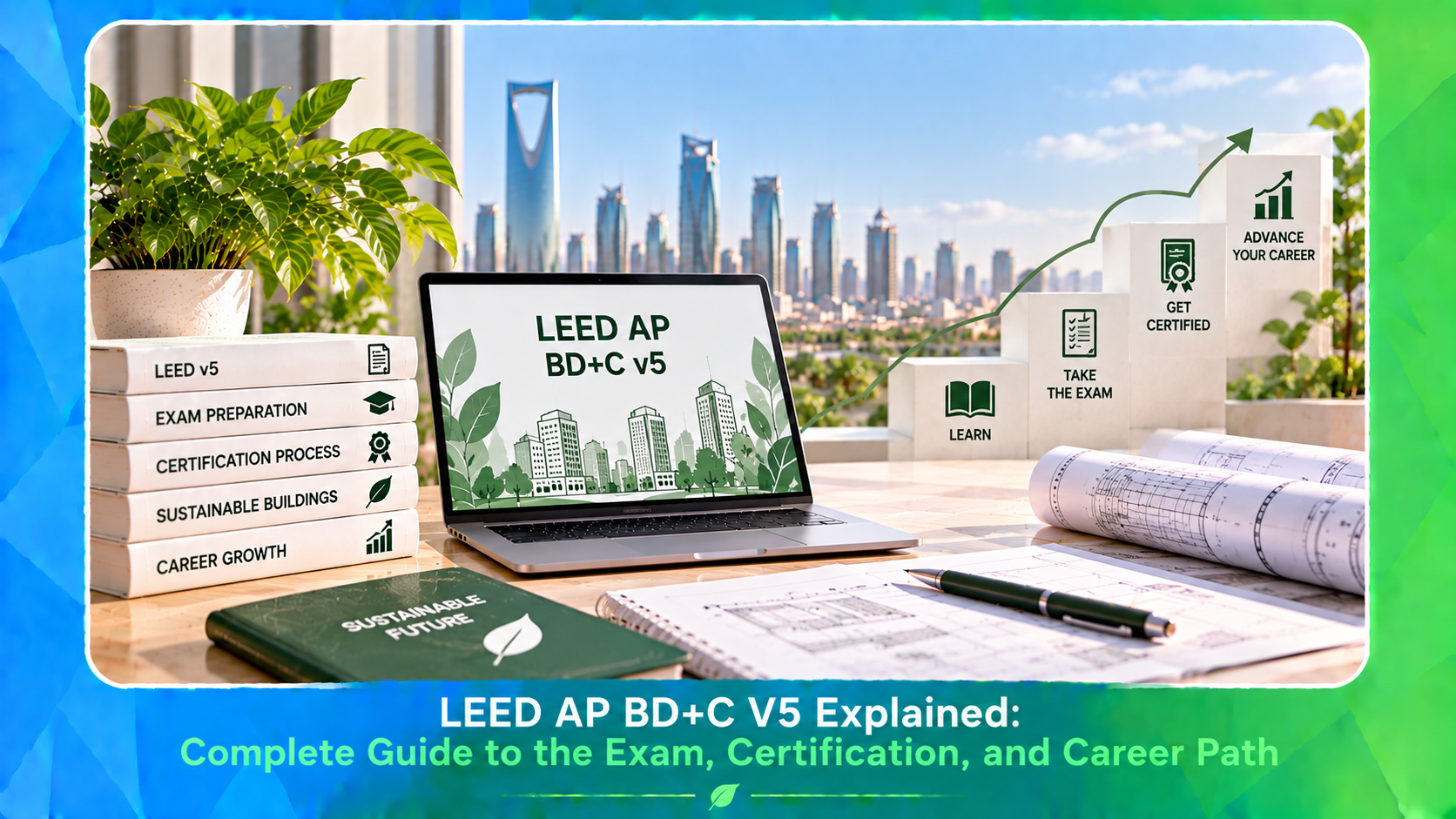
LEED AP BD+C V5 Explained: Complete Guide to the Exam, Certification, and Career Path
If you are an engineer, architect, contractor, sustainability consultant, or construction professional looking to advance your career in green building, understanding LEED AP BD+C V5 can be an important step toward professional specialization.
LEED has become one of the most recognized frameworks for evaluating sustainable building performance, and professionals who understand how to apply LEED principles can play an important role in the design and construction of high-performance buildings.
But what exactly does LEED AP BD+C mean? What does the BD+C specialty focus on? Who should pursue it? How difficult is the exam, and what is the best way to prepare?
This guide provides a complete explanation of LEED AP BD+C V5, including its purpose, professional value, exam preparation strategy, study methods, practice tests, and the skills candidates should develop before taking the exam.
Whether you are researching your first LEED credential or already preparing for an advanced LEED AP pathway, understanding the relationship between LEED AP, Building Design and Construction, and the latest LEED requirements can help you create a more effective certification strategy.
What Is LEED AP BD+C V5?
LEED AP BD+C stands for Leadership in Energy and Environmental Design Accredited Professional with a specialty in Building Design and Construction.
The credential is designed for professionals who work with the planning, design, construction, and delivery of buildings and want to demonstrate advanced knowledge of LEED principles within the Building Design and Construction specialty.
The BD+C specialty is particularly relevant to professionals involved in new construction and major building projects where sustainable design and construction strategies are integrated into the project from the early planning stages.
Unlike a general introduction to green building, LEED AP BD+C requires candidates to understand how sustainability concepts can be applied within actual building projects.
This includes understanding relationships between building performance, energy efficiency, water efficiency, materials, indoor environmental quality, site strategies, and other sustainability considerations.
When people search for LEED AP BD+C V5 Explained, they are often looking for more than a definition of the credential. They want to understand what the specialty means in practical terms and how it can help them prepare for an advanced LEED career.
The key idea is simple: LEED AP BD+C represents specialized knowledge for professionals working with sustainable building design and construction.
What Does BD+C Mean in LEED?
The abbreviation BD+C means Building Design and Construction.
This specialty focuses on the sustainability considerations involved in designing and constructing buildings. It is therefore particularly relevant to architects, engineers, contractors, project managers, consultants, and other professionals who participate in building projects.
Understanding BD+C requires a project-level perspective.
A sustainable building is not created by applying one isolated strategy. Instead, performance is influenced by multiple decisions made throughout the project lifecycle.
For example, decisions about site selection can affect transportation and environmental performance. Building envelope decisions can influence energy demand. Mechanical systems can affect energy efficiency and indoor environmental quality. Material choices can influence resource consumption and environmental impacts.
This interconnected approach is one of the reasons that LEED AP BD+C requires more than memorizing individual sustainability concepts.
Professionals need to understand how different strategies work together and how decisions made during design and construction can influence the overall performance of a building.
For candidates preparing for the LEED AP BD+C Exam, developing this project-based mindset is therefore essential.
Why Is LEED AP BD+C Important for Building Professionals?
The construction industry is increasingly focused on energy performance, resource efficiency, occupant well-being, resilience, and sustainable development.
As a result, professionals who understand sustainable building principles can bring valuable knowledge to multidisciplinary project teams.
A professional with LEED AP BD+C knowledge can better understand the sustainability objectives of a building project and communicate with architects, engineers, contractors, owners, and sustainability consultants.
The value of the credential is not simply the letters added after your name.
Its professional value comes from demonstrating specialized knowledge that can be connected to real project decisions.
For an engineer, this may mean understanding how building systems and energy strategies interact with LEED requirements.
For an architect, it may mean integrating sustainability into design decisions from the earliest project stages.
For a contractor, it can mean understanding how construction practices, documentation, materials, and project implementation contribute to sustainability objectives.
For a sustainability consultant, the credential can support deeper specialization in LEED project delivery.
Therefore, LEED AP BD+C Certification can be particularly useful when it complements existing technical experience.
What Does LEED AP BD+C V5 Cover?
Understanding the scope of LEED AP BD+C V5 is an important part of effective exam preparation.
The knowledge required for an advanced LEED credential extends across several areas of sustainable building performance. Candidates need to understand not only individual sustainability concepts but also how they interact within the context of building design and construction.
Important areas can include sustainable site strategies, water-related considerations, energy and building performance, materials and resources, indoor environmental quality, and integrated approaches to sustainability.
The exact requirements and exam content should always be checked against the latest official materials because LEED rating systems and credentialing requirements can evolve.
The broader principle remains consistent: candidates need to understand how sustainable strategies contribute to building performance and how project teams can incorporate them into the design and construction process.
For example, energy efficiency should not be studied as an isolated topic. Candidates should understand how design decisions, systems, building envelope strategies, controls, commissioning, and operational considerations can influence energy performance.
The same approach applies to water, materials, site, and indoor environmental quality.
A strong LEED AP BD+C Study Guide should therefore help candidates connect concepts rather than memorize disconnected facts.
LEED AP BD+C V5 and the Evolution of LEED
One of the most important considerations when preparing for any LEED credential is using current and reliable information.
LEED has evolved over time as the green building industry has changed. New priorities, technologies, performance expectations, and sustainability challenges have influenced how green building frameworks are developed.
This means candidates should be careful when using older study materials.
A study guide created for a previous version may contain useful background information, but it may not accurately represent the current requirements or priorities.
This is particularly important for anyone searching for LEED AP BD+C V5 Explained because the word V5 signals a specific version and context.
Rather than assuming that information from previous LEED versions remains identical, candidates should verify their study materials against current official resources.
At LEED Tricks, keeping preparation resources aligned with the intended exam and current learning objectives is an important part of creating an effective study experience.
The goal is to help candidates spend their preparation time learning relevant information rather than trying to determine which outdated information still applies.
Who Should Take the LEED AP BD+C Exam?
The LEED AP BD+C Exam can be relevant to a wide range of professionals involved in building design and construction.
Architects may pursue the credential to strengthen their knowledge of sustainable design and LEED project requirements.
Engineers can use the knowledge to better understand how technical building systems interact with sustainability objectives.
Contractors and construction managers may benefit from understanding how construction decisions and implementation affect project sustainability.
Sustainability consultants can use the credential to strengthen their specialization in green building certification and project support.
Project managers can also benefit because LEED involves coordination between multiple disciplines and project stakeholders.
The ideal candidate is not defined solely by job title.
What matters is the relationship between the professional's responsibilities and sustainable building projects.
If your work involves building design, construction, project coordination, sustainability, energy performance, or LEED certification, exploring the BD+C specialty may make sense.
Candidates should also evaluate their current knowledge before deciding how much preparation they need.
Someone with extensive LEED project experience may require a different study strategy from someone who understands sustainability concepts but has never participated in a LEED project.
How Difficult Is the LEED AP BD+C Exam?
The difficulty of the LEED AP BD+C Exam depends on several factors, including professional experience, familiarity with LEED terminology, understanding of sustainable building principles, and preparation quality.
One of the biggest mistakes candidates make is assuming that the exam can be passed through memorization alone.
Advanced LEED questions can require candidates to understand a concept and apply it to a situation.
This means that simply memorizing definitions may not provide enough preparation.
Candidates should learn to identify the important information in a question, understand what the scenario is asking, eliminate incorrect options, and select the response that best matches the applicable principle.
Time management can also influence exam performance.
A candidate may understand the material but still struggle if they spend too much time on difficult questions.
This is why a strong preparation plan should include timed practice.
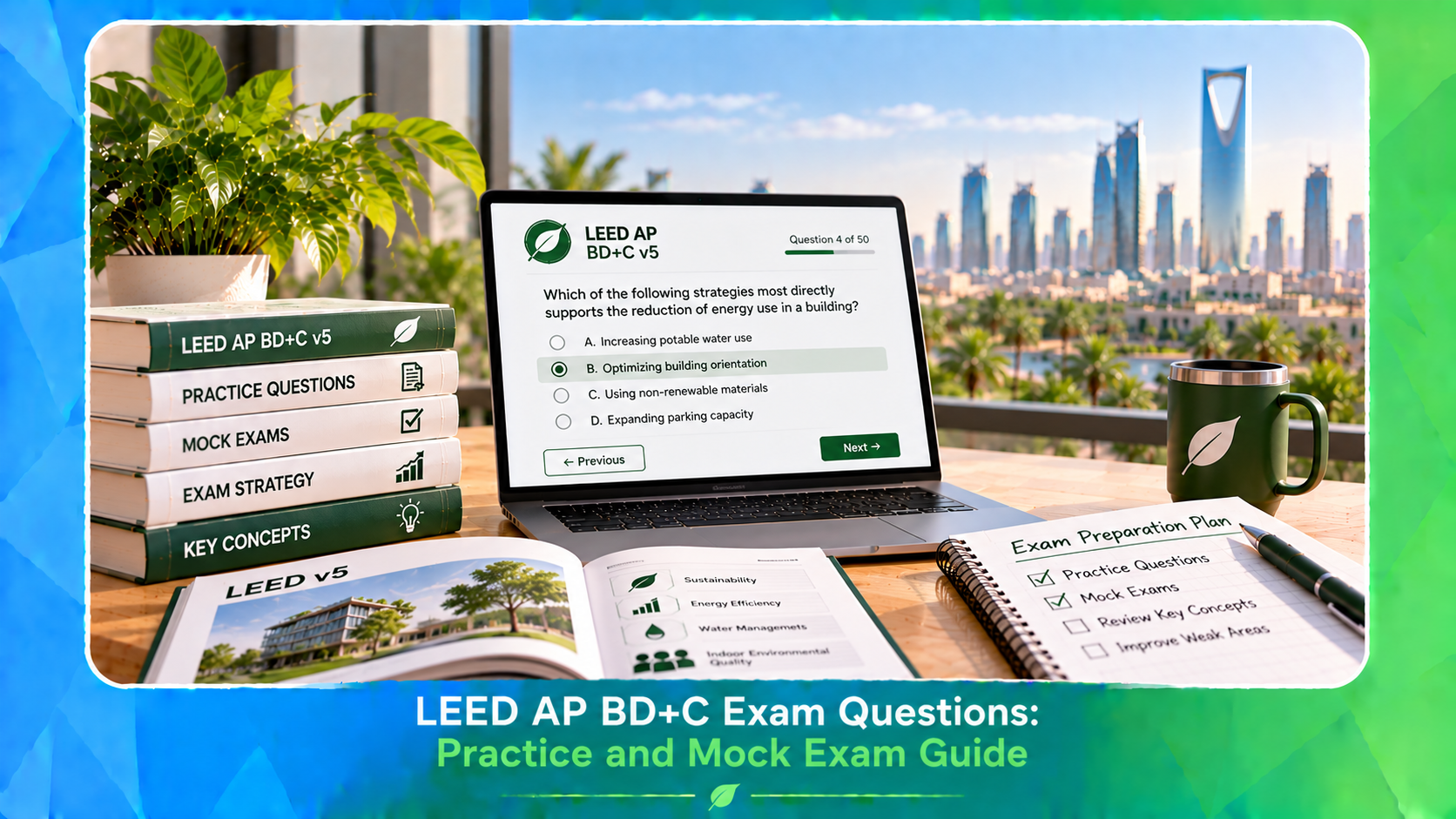
Using LEED AP BD+C Practice Tests can help candidates become familiar with the process of answering questions under realistic conditions.
The objective is not to memorize practice test answers.
The objective is to improve understanding, decision-making, accuracy, and speed.
How to Prepare for the LEED AP BD+C V5 Exam
A successful LEED AP BD+C V5 Exam Preparation strategy should combine structured learning with continuous testing.
Start by understanding the exam scope and identifying the major topics you need to study.
Then divide the material into manageable study sessions.
Instead of studying everything at once, focus on one major topic at a time and make sure you understand its purpose, terminology, relationships, and practical application.
After studying a topic, use practice questions to evaluate your understanding.
If you make mistakes, do not simply memorize the correct answer.
Ask why your answer was wrong.
Was the concept misunderstood? Did you miss an important word in the question? Did you confuse two related strategies? Did you choose an answer that was technically correct but less appropriate for the scenario?
This type of analysis creates much stronger exam preparation.
As your exam date approaches, increase the number of timed practice sessions and full mock exams.
Your final preparation stage should focus on identifying weak areas, reviewing difficult concepts, improving time management, and building confidence.
How to Build a LEED AP BD+C Study Plan
A structured study plan can make a significant difference in exam preparation.
Start by determining how much time you have before the exam.
If you have several weeks, divide the preparation period into learning, practice, review, and final simulation stages.
During the first stage, focus on learning the concepts.
During the second stage, introduce regular practice questions.
During the third stage, begin taking longer practice tests and analyzing your performance.
During the final stage, use full mock exams to simulate the testing experience.
A useful study plan should also include time for reviewing mistakes.
For example, if you consistently miss questions related to energy performance, do not simply take another random test.
Return to the relevant study material, identify the knowledge gap, and then test yourself again.
This approach is much more effective than repeatedly taking practice exams without reviewing your errors.
The best LEED AP Study Guide is therefore not necessarily the longest one.
It is the one that helps you understand the material, organize your study time, and identify exactly what you need to improve.
LEED AP BD+C Practice Tests: Why They Matter
LEED AP BD+C Practice Tests are one of the most useful tools for evaluating exam readiness.
A practice test gives you more than a score.
It can reveal which topics you understand and which areas require additional study.
For example, you may discover that you perform well on general sustainability concepts but struggle with questions involving detailed project scenarios.
That information allows you to adjust your study plan.
Practice tests can also help improve time management.
Many candidates spend too much time analyzing one difficult question and then feel rushed later.
Repeated practice can teach you when to move forward and return to a difficult question later when appropriate.
However, practice tests should be used correctly.
Do not treat them as a collection of answers to memorize.
Instead, review every incorrect answer and, when possible, understand why each option is right or wrong.
A high-quality LEED AP BD+C Mock Exam should challenge your understanding and help you identify areas that need improvement.
The ultimate goal is to make your performance more consistent before taking the actual exam.
LEED AP BD+C Mock Exam vs Practice Test
Although the terms practice test and mock exam are often used interchangeably, they can serve slightly different purposes during preparation.
A practice test can be used during the learning stage to evaluate a particular topic or group of topics.
For example, after studying energy-related concepts, you can use targeted questions to see whether you understand the material.
A mock exam is more useful when you want to simulate the complete testing experience.
A full LEED AP BD+C Mock Exam should ideally require you to manage time, move between different topics, and make decisions without knowing what subject will appear next.
This makes mock exams especially useful during the final stages of preparation.
If your score is improving consistently across multiple simulations, you can have greater confidence that your knowledge and exam strategy are developing.
If your scores fluctuate significantly, investigate why.
The problem may be inconsistent knowledge, poor time management, fatigue, or difficulty interpreting scenario-based questions.
Use the results as information rather than simply as a pass-or-fail judgment.
Common Mistakes When Preparing for LEED AP BD+C
One of the most common mistakes is relying entirely on memorization.
LEED knowledge is interconnected, and candidates often need to understand why a strategy is appropriate rather than simply recognize its name.
Another mistake is studying from outdated resources.
Because LEED systems and credentialing requirements can evolve, candidates should make sure their preparation materials are appropriate for the exam they intend to take.
A third mistake is avoiding practice questions until the end of the study period.
Practice should begin during the learning process.
This allows candidates to discover misunderstandings early rather than discovering them shortly before the exam.
Another common problem is taking many practice tests without analyzing the results.
A test score alone does not tell you what you need to improve.
The most valuable part of a practice test is often the review that follows it.
Candidates should also avoid using too many unrelated study resources.
Collecting multiple books, videos, notes, question banks, and courses can create confusion rather than improve preparation.
A focused study system with reliable materials is generally more effective than an enormous collection of disconnected information.
LEED AP BD+C for Engineers and Architects
The BD+C specialty can be particularly relevant to engineers and architects because both professions influence major decisions that affect building performance.
Engineers may work with systems related to energy, water, HVAC, lighting, controls, or building performance.
Architects influence decisions involving site, orientation, envelope, materials, daylight, spatial planning, and other design considerations.
LEED AP BD+C knowledge can help both professions understand how individual technical decisions contribute to broader sustainability objectives.
For example, an engineer may understand the technical performance of a mechanical system but also need to consider how that system contributes to project-level sustainability goals.
Similarly, an architect may develop an excellent design but need to understand how material selection, energy performance, water use, and indoor environmental quality affect the project's sustainability strategy.
This interdisciplinary perspective is one of the most valuable aspects of studying LEED.
It encourages professionals to consider the building as an integrated system rather than a collection of independent components.
Career Benefits of LEED AP BD+C Certification
Obtaining LEED AP Certification can support professional development for people working in sustainable design, construction, consulting, engineering, architecture, and related fields.
The credential can demonstrate that you have invested in developing specialized knowledge of green building and LEED.
It can also help you communicate your sustainability expertise to employers, clients, project teams, and professional networks.
However, the strongest career value comes when certification is combined with real experience.
A credential alone does not replace technical expertise.
Instead, it can strengthen an existing professional profile.
For example, an engineer with experience in building systems and LEED AP BD+C knowledge can present a stronger sustainability-focused profile than someone with either credential knowledge or technical experience alone.
The same applies to architects, contractors, consultants, and project managers.
As sustainable building becomes increasingly important, professionals who can connect technical expertise with sustainability principles can become valuable members of multidisciplinary project teams.
What Should You Look for in a LEED AP BD+C Course?
Choosing the right LEED AP Course can simplify your preparation and reduce the amount of time you spend searching for disconnected resources.
A quality course should provide clear explanations of the concepts required for the target credential.
It should also include opportunities to test your understanding through practice questions and mock exams.
Updated content is especially important.
Candidates should make sure the course corresponds to the appropriate LEED version and current credentialing requirements.
A good course should also explain the reasoning behind questions rather than simply provide answers.
Look for training that helps you understand how concepts apply to real project situations.
The ideal course should combine structured lessons, study guidance, practice questions, performance analysis, and exam strategies.
At LEED Tricks, our approach is designed around helping candidates build understanding rather than relying exclusively on memorization.
The objective is to give professionals a structured path from learning the concepts to testing their knowledge and identifying the areas that require additional review.
How LEED Tricks Can Help You Prepare for LEED AP BD+C
Preparing for an advanced LEED credential can become overwhelming when you rely on scattered resources and do not have a clear study strategy.
LEED Tricks is designed to make the preparation process more structured by combining learning resources with practice and exam preparation.
Whether you are building your foundation in LEED or preparing specifically for LEED AP BD+C, the goal is to help you understand the material and become comfortable applying it.
A strong preparation process should include concept review, targeted practice, full mock exams, mistake analysis, and final revision.
Practice should not be treated as an optional stage.
It should be part of the learning process from the beginning.
By identifying weak areas early, you can focus your time where it will have the greatest impact.
If your goal is to earn a LEED credential and strengthen your professional position in sustainable building, a structured LEED AP BD+C Training program can help you move from general knowledge toward specialized exam readiness.
Explore LEED Tricks courses and choose the preparation path that matches your professional goals.
Frequently Asked Questions About LEED AP BD+C V5
What is LEED AP BD+C?
LEED AP BD+C is a LEED Accredited Professional specialty focused on Building Design and Construction. It is intended for professionals who want advanced knowledge related to sustainable building design and construction.
What does BD+C stand for in LEED?
BD+C stands for Building Design and Construction. The specialty focuses on sustainability considerations associated with the design and construction of buildings.
Is LEED AP BD+C difficult?
The difficulty depends on your background and preparation. Professionals with relevant experience may find the concepts more familiar, while candidates with limited LEED knowledge may need a longer preparation period.
How should I prepare for the LEED AP BD+C exam?
Start by understanding the current exam scope and study materials. Build your knowledge systematically, practice regularly, review mistakes, and complete timed mock exams before the actual test.
Are LEED AP BD+C Practice Tests useful?
Yes. Practice tests can help identify weak areas, improve time management, familiarize you with exam-style questions, and measure your progress.
What is the difference between a LEED AP BD+C Practice Test and a Mock Exam?
Practice tests can be used throughout the study process to evaluate specific areas. A mock exam is generally used to simulate the overall testing experience under timed conditions.
Is LEED AP BD+C useful for engineers?
Yes. Engineers involved in building design, construction, energy, sustainability, or project management can benefit from specialized knowledge of LEED BD+C.
Is LEED AP BD+C useful for architects?
Yes. Architects can use LEED knowledge to integrate sustainable strategies into design decisions and collaborate more effectively with multidisciplinary project teams.
Is LEED AP BD+C worth it?
For professionals whose careers involve sustainable design, construction, consulting, or LEED projects, the credential can be a valuable addition to their professional development.
What is the best way to study for LEED AP BD+C?
The most effective approach combines structured learning, current study resources, practice questions, mock exams, mistake analysis, and consistent revision.
Final Thoughts on LEED AP BD+C V5
Understanding LEED AP BD+C V5 Explained requires looking beyond the name of the credential.
LEED AP BD+C represents specialized knowledge related to sustainable building design and construction, making it particularly relevant to professionals who want to develop their expertise in green building and LEED project delivery.
The most important part of preparation is not memorizing as many facts as possible.
It is developing a strong understanding of sustainable building principles and learning how to apply that knowledge to project scenarios.
A structured preparation strategy can make this process much more effective.
Start by understanding the current requirements, build your knowledge systematically, practice consistently, analyze your mistakes, and use mock exams to evaluate your readiness.
For engineers, architects, consultants, contractors, and other building professionals, LEED AP BD+C can become an important part of a broader career strategy in sustainable design and construction.
If you are ready to take your LEED knowledge to the next level, start your preparation with LEED Tricks and build the skills and confidence you need for your LEED certification journey.
Latest posts
Copyright | LEED-Tricks All Rights Reserved . Made with MiskIts