LEED AP BD+C Exam Questions: Practice and Mock Exam Guide
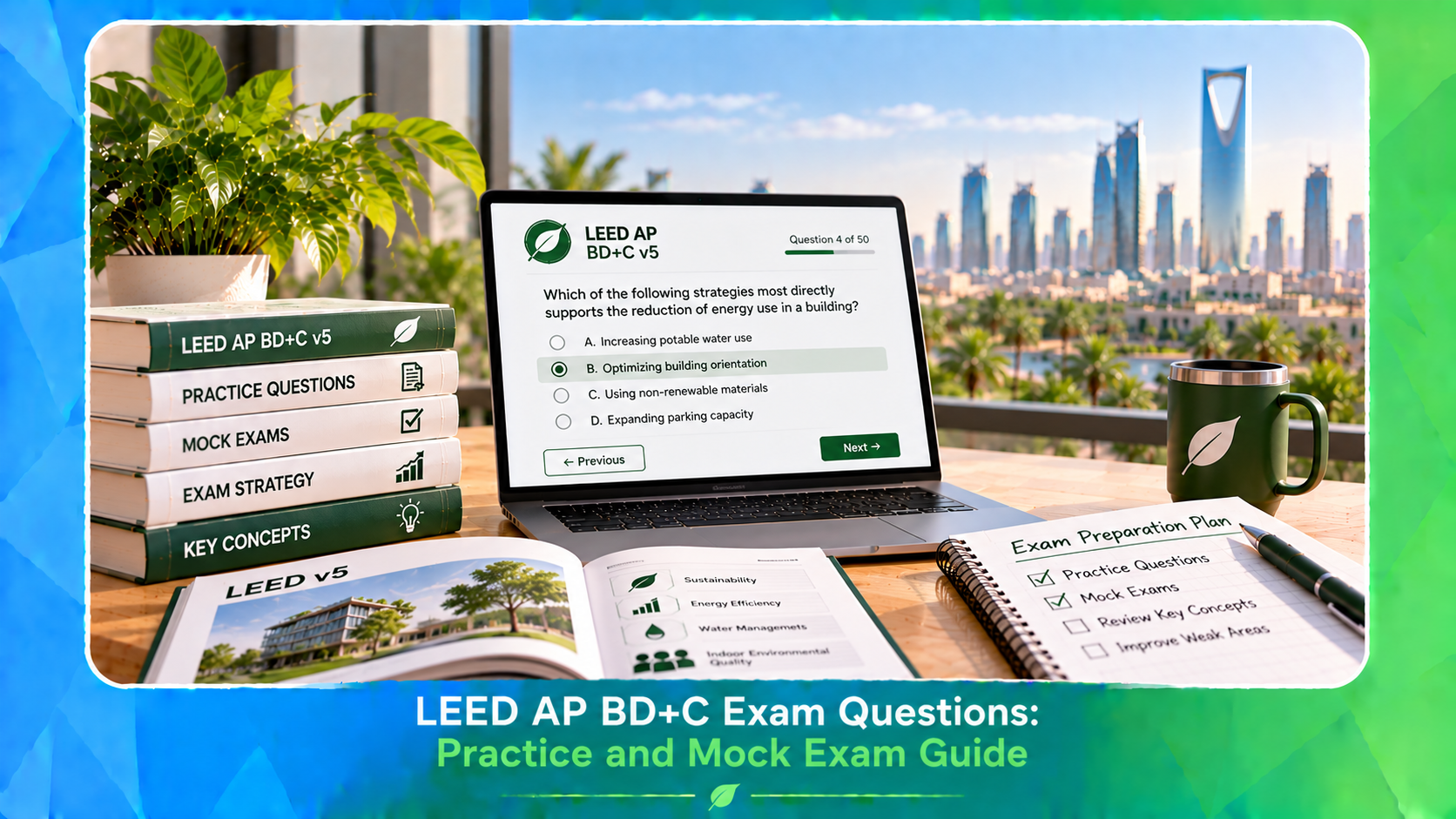
LEED AP BD+C Exam Questions: Practice and Mock Exam Guide
Preparing for the LEED AP BD+C exam requires more than reading study materials and memorizing terminology. Candidates also need to develop the ability to understand questions, evaluate answer choices, and apply their knowledge to different situations.
This is why LEED AP BD+C Exam Questions are an important part of an effective preparation strategy.
Practice questions allow candidates to move from passive learning to active application. They can reveal knowledge gaps, strengthen understanding, improve familiarity with exam-style questions, and build confidence before the actual exam.
However, effective practice is not simply about answering as many questions as possible.
The real value comes from understanding why an answer is correct, identifying why mistakes happen, and using those mistakes to guide further study.
This guide explains how to use LEED AP BD+C Exam Questions, how to combine practice questions with structured study, how mock exams can support your preparation, and how to turn incorrect answers into useful learning opportunities.
Why Are LEED AP BD+C Exam Questions Important?
Studying LEED AP BD+C content can help you build the knowledge required for the exam, but practice questions allow you to test whether you can actually apply that knowledge.
When you answer a question, you need to identify the relevant concept, understand what the question is asking, evaluate the available choices, and select the most appropriate answer.
This makes LEED AP BD+C Exam Questions much more than a simple memorization exercise.
Practice can also reveal weaknesses that are difficult to identify while reading.
You may feel comfortable with a topic because the information looks familiar in your study materials. However, when you encounter an exam-style question, you may realize that you are confusing two concepts or misunderstanding how they should be applied.
That information is extremely useful because it tells you where to focus your next study session.
What Makes LEED AP BD+C Exam Questions Useful?
Good practice questions should test more than your ability to remember definitions.
They should help you understand concepts and apply them.
Some questions may test direct knowledge, while others may require you to compare choices, identify the most appropriate strategy, or recognize the concept being described.
This is why variety matters.
Practice with different question formats, topics, and difficulty levels.
The more varied your training becomes, the easier it can be to approach unfamiliar questions.
Most importantly, treat every question as a learning opportunity.
A correct answer confirms your understanding.
An incorrect answer identifies an area that needs more attention.
How Should You Start Practicing LEED AP BD+C Exam Questions?
It is generally better to build a strong knowledge foundation before attempting large numbers of practice questions.
Begin by studying the relevant content.
After completing each major topic, answer a set of questions related to that topic.
Review your results carefully.
Once you have covered most of the content, move toward mixed question sets.
Mixed questions are important because they require you to identify the relevant concept without being told which topic the question belongs to.
This creates a more realistic practice experience and helps you develop the ability to recognize what a question is actually testing.
Why Should You Analyze Incorrect Answers?
One of the biggest mistakes candidates make is simply moving to the next question after getting an answer wrong.
An incorrect answer should be analyzed.
Ask yourself:
Why did I choose this answer?
Which concept did I misunderstand?
Did I confuse two similar ideas?
Did I misread the question?
Did I overlook an important word?
Did I choose an option because it sounded reasonable without fully understanding the underlying concept?
Different mistakes require different solutions.
If the problem is lack of knowledge, you need additional study.
If the problem is misreading or misinterpreting the question, you need more practice with question analysis.
Should You Memorize LEED AP BD+C Exam Questions?
Memorizing questions and answers is not an effective long-term strategy.
You may encounter a practice question during preparation and then see a different question testing the same concept during the actual exam.
If you have memorized only the previous answer, the new wording may be difficult.
If you understand the underlying concept, however, you can apply your knowledge even when the question is presented differently.
Use LEED AP BD+C Exam Questions to develop understanding rather than building a list of answers to memorize.
Practice Questions vs. Mock Exams
Practice questions and mock exams serve different purposes.
Practice Questions are usually used after studying a specific topic or group of concepts.
They allow you to immediately review an answer and identify knowledge gaps.
A Mock Exam provides a broader simulation of the testing experience.
During a mock exam, try to create conditions similar to an actual testing session.
Avoid stopping repeatedly to check answers.
Complete the test first, then analyze the results.
Both methods are important.
Practice questions support learning throughout the preparation process, while mock exams help you evaluate overall readiness.
How Can LEED AP BD+C Mock Exams Help?
Mock exams are particularly useful during the later stages of preparation.
Start with a mock exam to establish a baseline.
Analyze your performance and identify the topics where you made the most mistakes.
Return to your study materials and practice those areas.
After additional preparation, take another mock exam and compare your results.
Do not focus only on the score.
Look at the type of mistakes you are making.
Are the same topics still causing problems?
Are you answering questions faster?
Are you becoming more confident when evaluating answer choices?
Are you better able to explain why an answer is correct?
These indicators can tell you more about your progress than a single score.
How Do You Choose Good LEED AP BD+C Exam Questions?
When selecting practice questions, consider several factors.
First, make sure the questions are relevant to the exam content and version you are preparing for.
Second, look for variety across topics and levels of difficulty.
Third, prioritize resources that provide answer explanations.
Fourth, include both individual practice questions and comprehensive mock exams.
Finally, remember that practice questions should complement your study materials rather than replace them.
Questions are most useful when you already have a solid understanding of the concepts they are testing.
Why Are Answer Explanations Important?
Knowing the correct answer is not always enough.
Understanding why the answer is correct is much more valuable.
An explanation can also help you understand why other answer choices are less appropriate.
This is particularly important when multiple choices appear reasonable.
Learning the distinction between those choices can prepare you for unfamiliar questions.
When reviewing LEED AP BD+C Exam Questions, take the time to understand the reasoning behind the correct answer instead of simply checking whether you got it right.
How Should You Organize Practice Questions by Topic?
During the early stages of preparation, organize questions by topic.
This makes it easier to evaluate your understanding of individual areas.
If you perform well in one topic, you can move forward.
If you consistently struggle with another, return to your study materials and review the relevant concepts.
Later, introduce mixed question sets.
Mixed practice is valuable because it forces you to identify the topic and concept independently.
This helps develop the type of recognition and analysis required when questions are presented without topic labels.
Does the Number of Questions Matter?
The number of questions matters to a certain extent, but it should not be the main measure of preparation quality.
Completing hundreds of questions without reviewing mistakes can be less useful than completing a smaller number and carefully analyzing every answer.
Do not ask only how many questions you have completed.
Also ask:
What concepts have I improved?
Which mistakes have I stopped making?
Can I explain why an answer is correct?
Are my practice results improving?
These are better indicators of meaningful progress.
How Should You Use Questions During the Final Preparation Stage?
During the final stage, your focus should shift from initial learning toward review and application.
Use mixed question sets rather than relying only on topic-specific questions.
Add mock exams to your preparation schedule.
Review recurring mistakes.
Return to your study materials whenever a concept remains unclear.
Avoid trying to relearn everything from the beginning immediately before the exam.
Focus on the areas where your performance is weakest.
Common Mistakes When Using LEED AP BD+C Exam Questions
One common mistake is memorizing questions instead of understanding the concepts.
Another is ignoring questions that were answered correctly but with low confidence.
Those questions may reveal gaps in understanding even though the final answer was correct.
Using too many unorganized practice resources can also make preparation more confusing.
A focused set of high-quality resources is often easier to manage than constantly switching between different sources.
Finally, always make sure your practice materials are appropriate for the version of the exam you are preparing for.
How LEEDTricks Can Support Your Preparation
You can combine LEED AP BD+C Exam Questions with structured training and study resources from LEEDTricks.
Combining training, review, practice questions, and mock exams creates a more complete preparation process than relying on questions alone.
The more effectively you use practice results to identify weaknesses, the easier it becomes to determine what you should study next.
A Practical LEED AP BD+C Exam Questions Strategy
You can organize your practice into several stages.
Stage One: Study the Content
Build your foundational understanding of the relevant LEED AP BD+C concepts.
Stage Two: Practice by Topic
Complete practice questions after studying each major topic.
Stage Three: Track Mistakes
Record recurring mistakes and concepts that require additional review.
Stage Four: Mixed Practice
Move from topic-specific questions to mixed question sets.
Stage Five: Mock Exams
Use mock exams to measure your overall readiness and practice working through a comprehensive set of questions.
Stage Six: Final Review
Focus on recurring mistakes and difficult concepts before the exam.
This approach allows practice questions to support your preparation throughout the entire study process rather than becoming a last-minute activity.
Conclusion
LEED AP BD+C Exam Questions are one of the most useful tools for preparing for the LEED AP BD+C exam when they are used as part of a structured learning strategy.
Do not focus only on the number of questions you complete.
Focus on understanding the reasoning behind each answer, analyzing mistakes, and reviewing the concepts where your performance is weaker.
Start with topic-based practice, move toward mixed questions, and use mock exams during the later stages of preparation.
The goal is not to memorize a collection of questions.
The goal is to build a strong understanding of LEED AP BD+C concepts and develop the ability to apply that knowledge when you encounter new questions.
Frequently Asked Questions
What are LEED AP BD+C Exam Questions?
They are practice questions designed to help candidates review LEED AP BD+C concepts, test their knowledge, and prepare for the examination.
Should I memorize LEED AP BD+C questions?
No. Understanding the concepts and learning how to analyze questions is more valuable than memorizing specific questions and answers.
What is the difference between Practice Questions and Mock Exams?
Practice questions are generally used to test individual topics during study, while mock exams provide a broader simulation of the testing experience.
Why should I review incorrect answers?
Incorrect answers can reveal gaps in your knowledge or problems with question interpretation. Reviewing them helps you address those weaknesses before the exam.
Do I need to answer a large number of questions?
Not necessarily. The quality of practice and the depth of answer analysis are more important than simply reaching a high question count.
When should I start using Mock Exams?
Mock exams are generally most useful after you have built a solid foundation and covered a significant portion of the study material. They become increasingly valuable during the later stages of preparation.
Start Your LEED Certification Journey with LEED Tricks
Enhance your sustainability skills and get the training you need to prepare for professional certification exams with LEED Tricks courses
LEED Green Associate v5 Full Package
Everything you need to prepare for the exam in one comprehensive package including educational videos study resources flashcards chapter tests and full-length practice exams
Explore the Full Package and Get Started Now
LEED Green Associate v5 Exam Training Package
Ideal for learners who want to focus on practical exam preparation and assess their readiness through chapter tests and full-length practice exams
Explore the LEED Green Associate v5 Course
Learn more about the course content and available packages and choose the training option that best fits your goals
Explore the LEED Green Associate v5 Course
Green Project Manager GPM-b™
Develop your expertise in green project management and get specialized training to help you prepare for the Green Project Manager GPM-b™ certification
LEED AP BD+C | Arabic-English | v4
Prepare for the LEED AP BD+C credential with a bilingual Arabic-English training course designed to help you understand the exam content and prepare effectively
LEED AP O+M | Arabic-English
Enhance your knowledge of sustainable building operations and maintenance and prepare for the LEED AP O+M exam with Arabic-English training
Explore the LEED AP O+M Course
Choose the Right Course and Get Started Today
Whether you are preparing for your first LEED Green Associate certification looking to specialize as a LEED AP or aiming to develop your green project management skills LEED Tricks provides the training and resources you need to prepare with greater confidence structure and effectiveness
Take your next step toward a career in sustainability today
Latest posts
Copyright | LEED-Tricks All Rights Reserved . Made with MiskIts