LEED v5 Certification Guide: Everything You Need to Know
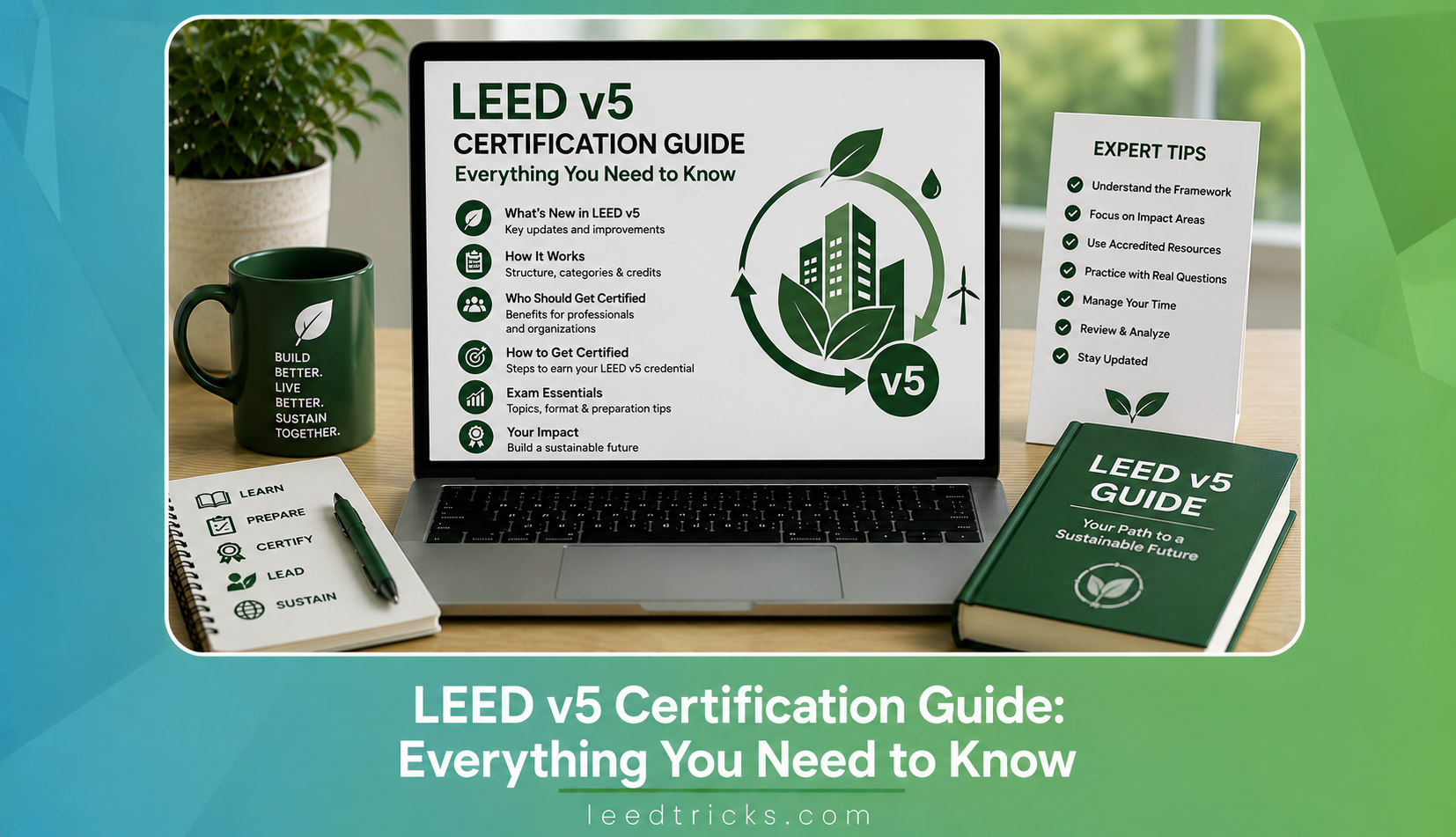
LEED v5 Certification Guide: Everything You Need to Know
LEED v5 represents the most advanced and transformative iteration of the green building rating system developed by the U.S. Green Building Council (USGBC). This version marks a paradigm shift in sustainability, focusing on four core strategic pillars: decarbonization, quality of life, ecological health and resilience, and social equity. Unlike previous versions that emphasized energy efficiency, LEED v5 adopts a holistic approach to ensure that buildings are not only environmentally friendly but also actively promote human health and strengthen community resilience against climate change.
Frequently Asked Questions: LEED v5 Certification & Credentialing
Where can I learn more about LEED v5 certification?
To gain accurate and reliable information regarding LEED v5, it is essential to consult the official resources provided by the U.S. Green Building Council (USGBC). The official USGBC website offers comprehensive reference guides, technical documentation detailing rating requirements, and updates on project registration processes. Additionally, you can leverage specialized educational platforms like LEED-Tricks. At LEED-Tricks, we provide professional, simplified explanations and educational content that help you grasp these new standards clearly, offering accredited and reliable courses to help you achieve your certification goals with confidence.
Where can I learn more about LEED v5 credentialing exams?
Professional credentialing exams are managed by the Green Business Certification Inc. (GBCI). You can access all details concerning exam registration, available testing windows, and Candidate Handbooks through your Credentialing Dashboard. The process typically includes options for standard testing or specialized beta exams launched during the transition to new versions. At LEED-Tricks, we support your preparation for these rigorous exams through proven study strategies and practice questions that simulate the actual testing environment, ensuring you are well-prepared to pass on your first attempt.
I am with the press—who can I speak with about the release of USGBC's latest version of LEED?
For press and media inquiries regarding the launch of the latest version of LEED, the U.S. Green Building Council (USGBC) directs media representatives to reach out via the Contact Us page on their official website. Media inquiries are routed to their Public Relations team to ensure you receive accurate statements and official press releases regarding LEED v5. You may submit your request via the online contact form available at the USGBC/GBCI Support Center, where their team will direct your inquiry to the appropriate department to assist with your coverage request.
Would you like to know more about how to begin your study journey with LEED-Tricks to ensure you are fully prepared to pass the new professional credentialing exams?
The transition to LEED v5 marks a significant evolution in green building standards, shifting the focus toward decarbonization, social equity, and climate resilience. Below is a detailed breakdown of the current timelines, the mandatory nature of the update, and the sunset schedule for previous versions.
LEED v5 Transition Timeline and Deadlines
- Registration Close Date: The U.S. Green Building Council (USGBC) has extended the window for LEED v4 and v4.1 commercial registrations. You can continue to register new projects under these older versions until June 30, 2027.
- Mandatory Transition: Starting July 1, 2027, LEED v5 will become the only available path for new commercial registrations for the BD+C, ID+C, and O+M rating systems (with very limited exceptions).
- Existing Projects: If you have already registered a project under LEED v4 or v4.1, you may continue to pursue certification under those rules until the final sunset date.
Is the use of LEED v5 mandatory?
Yes, eventually. While you currently have the flexibility to choose between LEED v4/v4.1 and LEED v5 for new project registrations until June 30, 2027, the transition to LEED v5 will become mandatory for all new commercial registrations once that deadline passes.
For teams currently in the early stages of design, many are opting for LEED v5 to align their projects with the latest climate-focused benchmarks and future-proof their assets. However, projects that are already well into their design development (typically 30% or more) often find it more practical to register under the v4/v4.1 framework before the June 2027 cutoff to avoid the need for significant design rework.
When will LEED v4 and v4.1 be closed to new registrations and sunset?
It is important to distinguish between the registration close date and the certification sunset date:
- Registration Close Date: New project registrations for LEED v4 and v4.1 will officially close on June 30, 2027.
- Certification Sunset Date: Projects already registered under LEED v4 or v4.1 have a long runway to complete their certification. The final date to submit these projects for review (the sunset date) is June 30, 2033.
|
Milestone |
Date |
|
Last day to register new projects under LEED v4/v4.1 |
June 30, 2027 |
|
LEED v5 becomes mandatory for new projects |
July 1, 2027 |
|
Final deadline to submit v4/v4.1 projects for review |
June 30, 2033 |
Note: If you are managing projects for clients or preparing for professional exams, staying informed about these dates is critical for long-term project planning. At LEED-Tricks, we continuously update our study materials and resources to ensure you are prepared for both the current transition period and the new requirements under the LEED v5 framework.
Would you like to dive deeper into how the new LEED v5 prerequisites—such as the Climate Resilience Assessment or the Carbon Assessment—might impact your specific project pipeline?
Recertification Deadlines for LEED v4 O+M and LEED v4.1 O+M
Projects pursuing recertification under these versions must adhere to the following key dates:
- Registration Deadline: Projects must be registered for recertification by June 30, 2027.
- Submission Deadline (Sunset Date): Projects must submit all required documentation for review by June 30, 2033.
Important Note: A project is only eligible to register for recertification under LEED v4.1 O+M in the Arc platform if it has already completed at least one previous certification (either Design + Construction or Operations + Maintenance).
Deadlines for LEED v4.1 O+M: Interiors
The requirements for projects using the LEED v4.1 O+M: Interiors rating system align with the broader commercial deadlines:
- Registration Deadline: You must register these projects by June 30, 2027.
- Submission Deadline (Sunset Date): All certification applications must be submitted for review by June 30, 2033.
Summary Table for Reference
|
Category |
Registration Close |
Sunset (Final Submission) |
|
LEED v4/v4.1 O+M (Recertification) |
June 30, 2027 |
June 30, 2033 |
|
LEED v4.1 O+M: Interiors |
June 30, 2027 |
June 30, 2033 |
These dates were last updated by the USGBC in May 2026. Because these timelines are critical for maintaining your project's certification status, we recommend regularly checking your GBCI/USGBC Credentialing Dashboard for any project-specific notifications.
At LEED-Tricks, we keep our guidance aligned with these latest updates to ensure your certification journey remains smooth and compliant. Would you like assistance in preparing the documentation strategy for a specific recertification project?
Transitioning from LEED v4/v4.1 to LEED v5
Yes, projects currently registered under LEED v4 or LEED v4.1 have the opportunity to switch to LEED v5.
- Recommendation: If you believe LEED v5 is a better fit for your project’s sustainability goals, contact the USGBC support team to discuss the transition.
- Consideration: Be aware that requirements differ significantly between versions. If you choose to switch, you may need to update previously completed project documentation and forms to align with the new LEED v5 prerequisites and credit pathways.
LEED v5 Eligibility and Certification Approaches
LEED v5 is designed to provide a more data-driven, holistic approach to building performance.
- Eligibility: Certification is available for commercial rating systems, including BD+C (Building Design and Construction), ID+C (Interior Design and Construction), and O+M (Operations and Maintenance).
- Certification Path: The process begins by selecting the appropriate rating system for your project type and setting clear sustainability goals. Note that some LEED v5 O+M credit forms are still in active development, so it is recommended to reach out to the USGBC if you are nearing the submission phase.
Guidance on LEED v5 Minimum Program Requirements (MPRs)
The Minimum Program Requirements (MPRs) for LEED v5 remain the same as those for LEED v4.
- Core Standards: Every project must still be in a permanent location on existing land, use reasonable LEED boundaries, and comply with minimum floor area requirements (e.g., 1,000 sq. ft. for BD+C and O+M; 250 sq. ft. for ID+C).
- Where to find help: You can continue to use the existing supplemental guidance for MPRs available in the LEED Credit Library and the USGBC Help Center.
Campus, Group, and Volume Approaches
Currently, the LEED campus, group, and volume approaches are NOT available for LEED v5 projects.
- Limitation: LEED v5 projects cannot register within or utilize existing LEED v4 or v4.1 master sites or campus boundaries.
- Strategy: If your project specifically requires these multi-building or portfolio-wide streamlining approaches, you must register under LEED v4 or LEED v4.1 at this time. The USGBC has not yet released specific guidance or functionality for these approaches in the LEED v5 framework, so it is recommended to monitor the official LEED v5 page for future announcements.
At LEED-Tricks, we closely track these policy shifts to help you navigate the best certification path for your specific project. Would you like to explore how to best position a multi-building development while waiting for these approaches to become available in future versions?
Can residential projects use LEED v5 BD+C?
Yes, with specific conditions.
- Multi-family Residential: Buildings with at least four above-grade floors are eligible to pursue certification using LEED v5 BD+C.
- Smaller Residential Projects: For residential projects with three floors or less, the U.S. Green Building Council (USGBC) currently directs teams to continue using LEED v4 or LEED v4.1. You can verify the specific rating system eligibility for your project type through the USGBC’s official rating system guide.
Is LEED v5 recertification currently available?
Yes.
- Availability: LEED v5 O+M recertification is currently active and managed through the Arc platform.
- Process: If you are pursuing recertification, you should register your project in Arc. If your project is already established in the platform, be sure to use the existing property profile to maintain data continuity.
- Pro Tip: Projects that have been previously certified can earn an additional 5 points by completing the LEED Recertification credit found under the Project Priorities (PR) category in the LEED v5 scorecard.
Are there LEED v5 requirements for LEED Zero?
Not yet.
- Current Status: There are no specific LEED v5 requirements for the LEED Zero program at this time. The existing LEED Zero program requirements remain the most current and applicable standards.
- Strategy: While LEED v5 emphasizes decarbonization—making it a natural partner for LEED Zero goals—you should continue to follow the established LEED Zero documentation pathways for Carbon, Energy, Water, and Waste certifications.
Summary Table for Quick Reference
|
Question |
Status |
Guidance |
|
Residential (4+ floors) |
Available |
Eligible for LEED v5 BD+C. |
|
Residential (≤ 3 floors) |
Not Available |
Use LEED v4 or v4.1. |
|
LEED v5 Recertification |
Available |
Register via the Arc platform. |
|
LEED v5 for LEED Zero |
Not Applicable |
Continue using current LEED Zero standards. |
At LEED-Tricks, we are closely monitoring the integration of LEED Zero into the v5 framework. Would you like assistance in planning a roadmap to achieve both LEED v5 certification and LEED Zero status for your current project?
How to Register a LEED v5 Project
Registration for LEED v5 is conducted through the Arc performance platform.
- For New Projects: If your property is not yet in the system, select Create new within Arc to initiate the registration process.
- For Existing Projects: If you are pursuing LEED v5 O+M and your building already has a profile in Arc, you should select Use existing. This links the project’s historical performance data to your new LEED v5 certification efforts, ensuring continuity.
- Official Rating Systems: Registration is currently available for:
- LEED v5 BD+C: New Construction.
- LEED v5 BD+C: Core and Shell.
- LEED v5 ID+C: Commercial Interiors.
- LEED v5 O+M: Existing Buildings.
Fees for LEED v5
The fee structure for LEED v5 follows the same schedule as previous versions. Fees consist of two primary components:
- Registration Fee: This is a flat fee paid upfront to open your project workspace.
- USGBC Members: $1,350
- Non-members: $1,700
- Certification Fee: This is the review fee, which scales based on your project's rating system and gross floor area (square footage). While costs vary, they are typically calculated based on a per-square-foot rate (for example, BD+C projects often range from approximately $0.056 to $0.076 per square foot, with specific minimums).
Note: LEED registration and certification fees are determined based on the schedule published at the time your project generates an invoice.
3. Where to Find Credit Forms and Calculators
All LEED v5 credit forms and calculators are integrated directly into the Arc platform.
- Accessing Forms: Once your project is registered in Arc, you can access the credit forms within your project dashboard.
- Sample Forms: If you wish to review the credit documentation requirements before formally registering your project, you can view sample forms directly within Arc.
- Best Practices for Calculators:
- Always download the latest version of a calculator from the Resources tab of the specific credit or prerequisite.
- Use the desktop version of Microsoft Excel, as some calculators are not fully supported by the online version.
- Enable macros when prompted, as these are essential for the calculators to function correctly.
Important Reminders for Your Practice
- LEED v5 O+M Note: Some LEED v5 O+M credit forms are still in active development. If you are preparing to submit your project and encounter missing forms, reach out to the USGBC support team for guidance.
- Review Process: Project teams can currently apply for certification using the standard review process available in Arc. The split review process for LEED v5 BD+C and ID+C will be implemented in the coming months.
At LEED-Tricks, we recommend keeping a close watch on the official USGBC Support Center for real-time updates regarding credit form releases. Would you like us to help you draft a checklist for the initial registration documentation to share with your clients?
Strategic Contextual Placement
Instead of a generic advertisement, place your platform where the reader needs help most—at the intersection of theory and application.
- During Technical Explanations:
- While the USGBC provides the regulatory framework for LEED v5, mastering the practical application and exam-specific logic is a different challenge. At LEED-Tricks, we specialize in deconstructing these complex requirements, offering verified, accredited study materials that simplify your path to certification.
- When Discussing Deadlines:
- With the June 2027 transition deadline approaching, staying informed is critical. Many project teams and exam candidates use LEED-Tricks to stay updated on shifting policies, ensuring their projects remain compliant and their professional credentials stay competitive.
End every technical response with a compelling invitation to your site. This converts a reader into a student.
Master LEED v5 with LEED-Tricks
Don’t leave your certification to chance. Whether you are navigating the transition from LEED v4.1 or preparing for your first credentialing exam, LEED-Tricks provides the authoritative, accredited, and simplified content you need to succeed.
LEED-Tricks is a leading educational platform dedicated to simplifying the complexities of green building certification. We provide verified, professional-grade study materials and expert guidance tailored for LEED v5 credentialing exams. Our mission is to bridge the gap between sustainability theory and professional mastery, empowering the next generation of industry leaders with accredited and reliable learning pathways.
Would you like me to draft a series of short, professional Tips & Tricks posts for LinkedIn or Instagram that link back to your site?
The Ballot Approval Process
The ballot approval process is the mechanism by which the USGBC formalizes and adopts technical standards. It is a multi-step workflow designed to incorporate feedback from a wide range of sustainability experts:
- Draft Development: Technical working groups and committees develop the content for the rating system based on current environmental data and industry best practices.
- Review and Comment: Proposed drafts undergo rounds of public comment, allowing stakeholders—such as architects, engineers, and project managers—to provide critique.
- Balloting: Once comments are addressed, the proposed standard is put to a formal vote. This is conducted by the Consensus Body, a group composed of diverse industry members who possess the technical expertise required to judge the viability of the rating system.
- Final Approval: If the ballot reaches the required consensus threshold, the draft moves toward final ratification.
Member Ratification
Member ratification is the final step of the consensus process. After the Consensus Body approves the technical content through balloting, the proposed LEED rating system is presented to the broader USGBC membership.
- Democratic Validation: This step ensures that the version has the support of the organization’s members, who represent the global green building community.
- Formal Adoption: A simple majority vote by the membership is typically required to ratify the system. Once ratified, the version is officially adopted, marking the transition from a draft standard to a formal, active version of the LEED rating system.
LEED v5 for Cities: First Public Comment Period
The U.S. Green Building Council (USGBC) is committed to an iterative development process for all LEED v5 frameworks. The first public comment period for LEED v5 for Cities and Communities was initiated in February 2024. This period allowed city planners, sustainability professionals, and community advocates to review the framework’s focus on equitable growth, climate resilience, and performance-based outcomes.
Master the Transition with LEED-Tricks
Understanding the development process behind LEED v5 is essential for professionals who want to stay ahead of the curve. However, grasping the technical application of these standards is where true expertise is built.
At LEED-Tricks, we bridge the gap between policy development and professional mastery. We don't just teach you the rules; we provide the accredited tools and exam strategies you need to apply them in real-world scenarios.
Ready to become an industry leader?
Would you like me to create a comparison chart between the previous LEED for Cities standards and the new v5 framework to help with your project planning?
LEED v5 undergoes a rigorous, transparent development process to ensure that the final rating systems are technically sound, market-ready, and highly impactful. Because this system is consensus-based, the U.S. Green Building Council (USGBC) relies heavily on iterative public feedback and formal voting blocks to shape the future of green building standards.
LEED v5 for Cities: Second Public Comment Period
The second public comment period for LEED v5 for Cities and Communities is scheduled following the extensive review and resolution of the feedback gathered during the initial comment phase (which launched in February 2024).
The USGBC utilizes these secondary review periods to present a refined draft that incorporates industry corrections and technical adjustments. Because exact committee review windows can shift based on the volume of comments received, the precise opening and closing dates for the second draft review are published directly on the USGBC development roadmap. Tracking these shifting phases is critical for urban planners and sustainability managers who want to align their long-term municipal strategies with the upcoming standards.
Who Can Participate in the Public Comment Period?
Participation in the second public comment period for LEED v5 for Cities is open to the entire public. The USGBC intentionally designs this process to be completely inclusive to capture a diverse range of perspectives.
You do not need to hold a LEED credential, and you do not need to be an active USGBC member to participate. Highly encouraged participants include:
- City planners, municipal leaders, and government officials.
- Sustainability consultants and environmental engineers.
- Academic researchers and community advocates.
- Architects, developers, and everyday citizens interested in urban resilience.
All feedback is submitted through the official USGBC online comment portal during the active window, and every unique comment receives a formal review from the technical committee.
Timeline for BD+C, ID+C, and O+M Ballot Approval
The blueprint for finalizing the core commercial rating systems—Building Design and Construction (BD+C), Interior Design and Construction (ID+C), and Operations and Maintenance (O+M)—follows a structured consensus timeline designed to prepare the market for the mandatory transition:
|
Phase |
Description |
Key Timing |
|
First Public Comment |
Initial drafts of BD+C, ID+C, and O+M released for industry-wide review. |
Opened April 2024 |
|
Review & Refinement |
Technical advisory groups address thousands of industry comments to update the credit language. |
Throughout 2024–2025 |
|
Subsequent Comments |
Focused public comment periods on revised credit weightings and prerequisites. |
2025 |
|
Formal Balloting |
The Consensus Body (a diverse group of registered stakeholders) votes to approve the technical integrity of the drafts. |
Late 2025 / Early 2026 |
|
Member Ratification |
Broad USGBC membership votes to officially adopt the rating systems into the active catalog. |
Mid-2026 |
Stay Ahead of the Curve with LEED-Tricks
As LEED v5 moves from the development and balloting phases into active project implementation, the demand for professionals who truly understand these updated credit mechanisms is growing rapidly. Staying updated on public comments and technical shifts can be overwhelming when managing active projects.
At LEED-Tricks, we handle the complexity for you. Our platform translates these evolving consensus updates into clear, actionable, and structured learning paths. We offer accredited, industry-trusted courses designed to give you a competitive edge, ensuring you master the exact criteria required to pass the latest credentialing exams on your very first attempt.
Visit LEED-Tricks today to explore our verified training programs and secure your credentials as a forward-thinking sustainability expert.
Latest posts
Copyright | LEED-Tricks All Rights Reserved . Made with MiskIts