LEED certification process overview
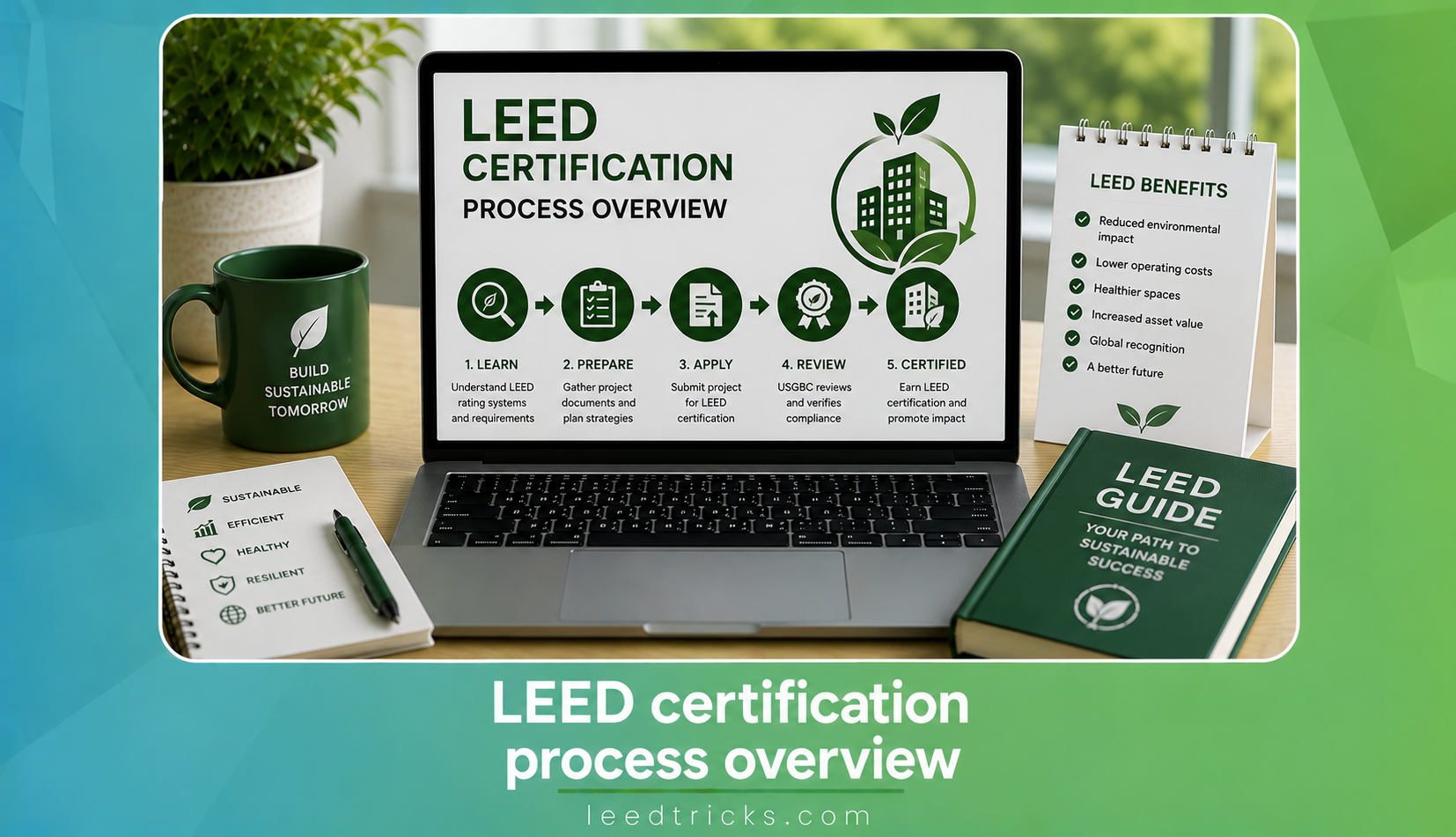
LEED certification process overview
LEED certification process overview is one of the most important topics for architects, engineers, developers, contractors, and sustainability professionals seeking to achieve internationally recognized green building certification. Understanding the certification process from the very beginning helps project teams establish realistic sustainability goals, prepare the required documentation, allocate responsibilities, and maximize the number of LEED credits available throughout the project lifecycle.
Unlike many building certification programs, LEED follows a structured and transparent evaluation system that assesses every stage of a building's development—from planning and design to construction, operation, and long-term environmental performance. Each project must demonstrate compliance with mandatory prerequisites while earning additional credits across multiple sustainability categories, including energy efficiency, water conservation, indoor environmental quality, sustainable materials, and site development.
Whether you are pursuing LEED Certified, Silver, Gold, or Platinum certification, having a clear understanding of the LEED certification process overview enables your team to make informed decisions, minimize certification risks, avoid unnecessary costs, and improve the project's overall sustainability performance. In this guide, we'll walk through every stage of the LEED certification process, explaining what happens at each step, who is involved, and how to successfully achieve certification.
LEED Certification Process Overview
The LEED certification process is a comprehensive framework established by the U.S. Green Building Council (USGBC) and administered by Green Business Certification Inc. (GBCI). It provides an independent, third-party verification system that evaluates how effectively a building incorporates sustainable design, environmentally responsible construction practices, and efficient building operations.
Rather than being a single application submitted at the end of construction, LEED certification is an ongoing process that begins during the project's planning phase and continues through design, construction, documentation, review, and final certification. Every sustainability strategy implemented throughout the project must be supported with detailed evidence, calculations, technical reports, and product documentation before certification can be awarded.
Projects are evaluated using a points-based rating system. While all projects must satisfy a set of mandatory prerequisites, they can earn additional credits by implementing advanced sustainability measures. The total number of points achieved determines the project's certification level, ranging from Certified to Platinum.
Successfully navigating the LEED certification process requires careful planning, early collaboration among project stakeholders, continuous documentation, and a thorough understanding of the applicable LEED rating system. By integrating sustainability into every stage of project delivery, organizations can improve environmental performance, reduce operating costs, increase occupant well-being, and demonstrate leadership in sustainable construction.
Select the Appropriate LEED Rating System
The first and arguably most critical step in the LEED certification process is selecting the appropriate LEED Rating System for your project. Since different building types have unique design requirements, operational characteristics, and sustainability objectives, LEED provides multiple rating systems tailored to specific project categories.
Choosing the correct rating system ensures that the project is evaluated against the most relevant sustainability criteria and avoids unnecessary documentation or compliance issues later in the certification process.
The primary LEED rating systems include:
- LEED Building Design and Construction (BD+C): Designed for new construction projects and major renovations.
- LEED Interior Design and Construction (ID+C): Intended for commercial interior fit-outs and tenant improvements.
- LEED Operations and Maintenance (O+M): Focused on improving the sustainability performance of existing buildings.
- LEED Homes: Developed specifically for residential buildings and housing developments.
- LEED Neighborhood Development (ND): Evaluates sustainable neighborhood planning and community development.
- LEED Cities and Communities: Supports sustainability planning at the municipal and district levels.
Selecting the wrong rating system can significantly affect the certification timeline and may require extensive revisions to project documentation. For this reason, many organizations engage a LEED Accredited Professional (LEED AP) during the early planning stage to determine the most suitable certification pathway and identify the credits that offer the greatest opportunity for success.
How Do Projects Earn LEED Certification?
Projects earn LEED certification by meeting a series of mandatory sustainability requirements and accumulating enough points within the LEED rating system established by the U.S. Green Building Council (USGBC). Rather than evaluating only the finished building, LEED assesses the environmental performance of a project throughout its planning, design, construction, and operational stages. Every project is independently reviewed by Green Business Certification Inc. (GBCI) to verify that it complies with LEED standards before certification is awarded.
The certification process begins by selecting the appropriate LEED rating system based on the project's type, such as new construction, interior design, existing buildings, homes, or neighborhood development. After registering the project through the LEED Online platform, the project team identifies the sustainability strategies and LEED credits they plan to pursue. These strategies are incorporated into the building's design and construction while ensuring that all mandatory prerequisites are fully satisfied.
Unlike traditional building certifications, LEED uses a points-based scoring system. Every project must first complete all required prerequisites, which represent the minimum environmental performance standards. Once these prerequisites have been met, projects can earn additional points by implementing sustainable practices across several performance categories, including energy efficiency, water conservation, sustainable site development, responsible material selection, indoor environmental quality, innovation, and regional priority initiatives.
Throughout the project, detailed documentation must be collected to demonstrate compliance with each selected credit. This documentation typically includes architectural drawings, energy simulation reports, commissioning reports, material certifications, waste management records, water efficiency calculations, and indoor environmental quality assessments. Accurate and well-organized documentation is essential because every claimed credit must be verified during the certification review process.
After all required documents have been prepared, the project team submits them through LEED Online, where they undergo an independent technical review conducted by Green Business Certification Inc. (GBCI). Reviewers evaluate each prerequisite and credit, request clarification if necessary, and determine the total number of approved points. If additional information is required, the project team has an opportunity to respond before the final review is completed.
The total number of approved points determines the project's certification level. LEED offers four certification levels that recognize increasing levels of environmental achievement:
|
LEED Certification Level |
Points Required |
|
Certified |
40–49 |
|
Silver |
50–59 |
|
Gold |
60–79 |
|
Platinum |
80–110 |
Projects that achieve higher certification levels demonstrate greater commitment to sustainability, improved resource efficiency, lower operating costs, healthier indoor environments, and reduced environmental impact. As a result, LEED-certified buildings often enjoy enhanced market value, lower utility expenses, stronger environmental credibility, and increased appeal to investors, tenants, and occupants.
Ultimately, projects earn LEED certification by integrating sustainability into every stage of development, carefully documenting their environmental performance, and successfully meeting the rigorous standards established by the LEED rating system. Through thoughtful planning, interdisciplinary collaboration, and continuous attention to sustainable design principles, organizations can achieve internationally recognized green building certification while contributing to a healthier and more sustainable built environment.
How Much Does LEED Registration and Certification Cost?
The cost of obtaining LEED certification varies depending on several factors, including the project's size, the selected LEED rating system, the level of certification being pursued, and whether the project owner is a member of the U.S. Green Building Council (USGBC). In general, LEED costs consist of two primary components: registration fees and certification review fees. However, many projects should also budget for consulting services, energy modeling, commissioning, documentation, and performance testing, which can significantly influence the overall investment.
LEED Registration Fee
The registration fee is a one-time payment made when a project is first entered into the LEED Online platform. Registering the project creates its official certification workspace, allowing project teams to upload documentation, assign responsibilities, and track certification progress throughout the review process.
The registration fee is relatively small compared to the total certification cost, but it is a mandatory first step before pursuing LEED certification.
LEED Certification Review Fee
After the project documentation has been completed, the project owner must pay the certification review fee. This fee covers the independent evaluation conducted by Green Business Certification Inc. (GBCI).
Certification review costs depend on several factors, including:
- The selected LEED rating system.
- The total project area.
- Whether the owner is a USGBC member.
- The project's complexity.
- Optional review services or appeals.
Large commercial developments generally have higher certification review fees than smaller projects because they require more extensive documentation and technical review.
Additional Costs to Consider
Beyond the official LEED fees, project owners should consider several indirect costs that contribute to successful certification, including:
- LEED Accredited Professional (LEED AP) consulting services.
- Energy modeling and simulation.
- Fundamental and enhanced commissioning.
- Building performance testing.
- Sustainable material verification.
- Documentation management.
- Indoor environmental quality testing.
- Water efficiency analysis.
Although these services increase the upfront investment, they often lead to long-term savings through reduced energy consumption, lower operating costs, and improved building performance.
Is LEED Certification Worth the Investment?
For many organizations, the benefits of LEED certification outweigh the initial costs. Certified buildings typically experience:
- Lower utility expenses.
- Improved energy efficiency.
- Reduced water consumption.
- Higher property value.
- Increased tenant satisfaction.
- Stronger environmental reputation.
- Better indoor environmental quality.
The long-term operational savings often help offset the initial certification expenses over the building's lifecycle.
What Is LEED Precertification?
LEED Precertification is an optional review process that allows project teams to demonstrate their commitment to achieving LEED certification before construction has been completed. It provides an early assessment of a project's planned sustainability strategies and confirms that the proposed design is aligned with LEED requirements.
Unlike full LEED certification, precertification evaluates the project's design intent rather than its completed construction. It does not represent the final certification but serves as an official indication that the project is on track to meet LEED standards.
Why Is LEED Precertification Important?
LEED precertification offers several strategic advantages, particularly for large commercial developments and projects seeking financing or early market recognition.
Some of the primary benefits include:
- Demonstrating sustainability commitments to investors.
- Supporting green financing applications.
- Increasing buyer and tenant confidence.
- Identifying potential certification challenges early.
- Reducing the risk of costly design changes later.
- Improving coordination among project stakeholders.
By obtaining precertification, project teams gain valuable feedback that can strengthen their certification strategy before construction progresses too far.
Who Should Consider LEED Precertification?
LEED precertification is especially valuable for:
- Commercial office developments.
- Mixed-use projects.
- Healthcare facilities.
- Educational institutions.
- Hospitality developments.
- Large residential communities.
- Government buildings.
Projects seeking public recognition of their sustainability goals before completion often benefit the most from this option.
How Do I Register and Certify a LEED Commercial Project?
Registering and certifying a LEED commercial project involves a structured sequence of steps designed to ensure compliance with internationally recognized green building standards.
Step 1: Select the Appropriate LEED Rating System
Begin by identifying the LEED rating system that matches your commercial project. Most new commercial buildings pursue LEED Building Design and Construction (BD+C), while tenant fit-outs typically use LEED Interior Design and Construction (ID+C).
Selecting the correct rating system ensures that the project follows the appropriate prerequisites and credit requirements.
Step 2: Register the Project
Once the rating system has been selected, register the project through the LEED Online platform. During registration, the project owner creates an official project profile, submits basic project information, and pays the registration fee.
Registration officially initiates the LEED certification process.
Step 3: Assemble the Project Team
Successful certification requires collaboration among professionals from multiple disciplines, including:
- Architects
- Structural engineers
- Mechanical engineers
- Electrical engineers
- Sustainability consultants
- LEED Accredited Professionals (LEED APs)
- Contractors
- Facility managers
Early collaboration helps integrate sustainability objectives into every stage of project delivery.
Step 4: Develop a Certification Strategy
The project team identifies which LEED credits are achievable based on the building's design, budget, and sustainability goals. This strategy helps maximize points while ensuring all mandatory prerequisites are satisfied.
Step 5: Implement Sustainable Building Practices
During design and construction, the team incorporates sustainable features such as:
- High-performance building envelopes.
- Energy-efficient HVAC systems.
- Water-saving plumbing fixtures.
- Renewable energy technologies.
- Sustainable construction materials.
- Construction waste diversion.
- Indoor air quality management.
Each sustainability measure contributes toward earning LEED credits.
Step 6: Prepare and Submit Documentation
Throughout the project, detailed documentation must be collected to verify compliance with LEED requirements.
Typical documentation includes:
- Energy models.
- Material certifications.
- Commissioning reports.
- Waste management records.
- Water efficiency calculations.
- Product environmental declarations.
- Indoor environmental quality reports.
All documentation is uploaded through LEED Online for review.
Step 7: Complete the GBCI Review Process
After submission, Green Business Certification Inc. (GBCI) performs an independent review of the project's documentation. If reviewers require clarification, the project team may submit additional information before the final decision is issued.
Step 8: Receive LEED Certification
Once all prerequisites have been met and sufficient credits have been approved, the project receives its final LEED certification level based on the total number of points earned.
Achieving LEED certification demonstrates that the commercial building meets globally recognized standards for sustainability, resource efficiency, occupant health, and environmental performance, while providing long-term operational and financial benefits for owners, tenants, and the surrounding community.
Advance Your Career with LEED Tricks
Looking to earn a globally recognized LEED certification and build a successful career in sustainable construction? LEED Tricks is your trusted learning partner. As the first accredited LEED training provider in the Middle East, LEED Tricks delivers high-quality, expert-led training programs designed to help professionals prepare for internationally recognized LEED credentials with confidence.
Whether you're pursuing the LEED Green Associate or LEED AP credential, our comprehensive courses combine up-to-date study materials, practical case studies, exam-focused preparation, and guidance from experienced instructors. Our flexible learning approach allows architects, engineers, project managers, sustainability consultants, contractors, and students to study at their own pace while gaining real-world knowledge that extends beyond the exam.
At LEED Tricks, we are committed to helping professionals achieve certification success and advance their careers in the rapidly growing green building industry. Join our community of sustainability professionals, enhance your expertise, and take the next step toward becoming a recognized leader in green building and environmental design.
Start your LEED certification journey today with LEED Tricks and gain the knowledge, confidence, and internationally recognized credentials needed to stand out in the global sustainability market.
Latest posts
Copyright | LEED-Tricks All Rights Reserved . Made with MiskIts